 MON - SAT 09: 00 AM - 06:00 PM (Sunday Closed)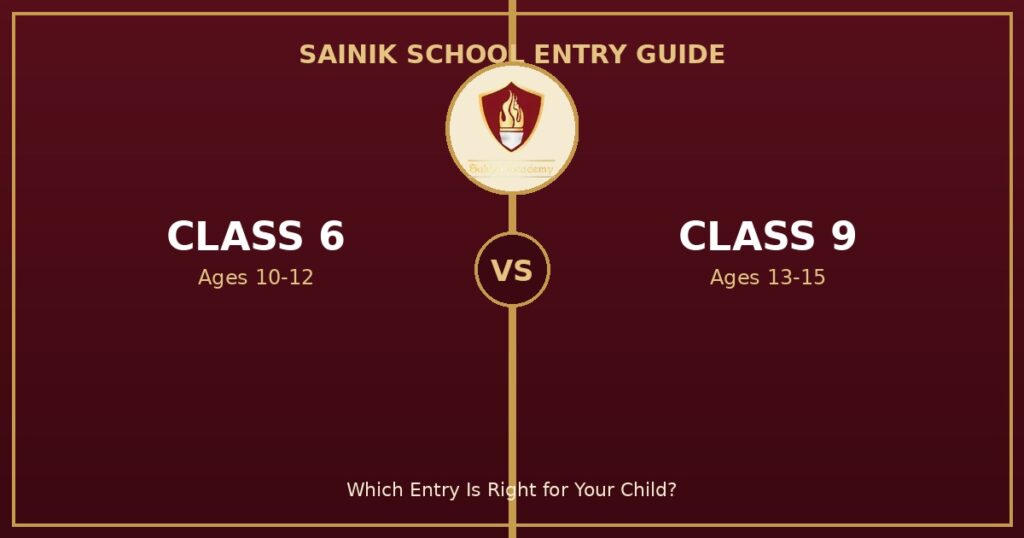
If your child is approaching either the Class 6 or Class 9 entry point, here is the short answer. Class 6 entry gives your child more years inside the Sainik School system. It also builds an easier runway into NDA later. Class 9 entry suits a child who is already doing well in a regular school. It offers a shorter, more focused path into defence exam preparation. Neither route is “better” in absolute terms. The right choice depends on your child’s current age and academic comfort level. It also depends on how early you want structured military-style training to begin.
Sainik Schools admit students through the All India Sainik Schools Entrance Examination, known as AISSEE. This exam runs twice a year for two separate entry classes. Understanding what each entry class involves is the first step. Only then can you compare them side by side.
Sainik School Class 6 Entry: What It Involves?
Class 6 entry is the traditional and most popular route into Sainik School. A child applying for Class 6 is typically between 10 and 12 years old. The exam tests Mathematics, Language, General Knowledge, and Intelligence. Because the child joins younger, they spend up to seven years inside the Sainik School environment. That means more time to adapt to hostel life and NCC-style drills. It also means more time for physical training and the school’s discipline culture, well before board exams or NDA preparation begin.
Sainik School Class 9 Entry: What It Involves?
Class 9 entry works differently. A child applying here is usually between 13 and 15 years old. The exam covers Mathematics, English, Intelligence, General Science, and Social Studies. This route suits students who performed well in a regular school. They switch into the Sainik School system with only three to four years left before Class 12. The transition window is shorter. Children entering at this stage often need a faster adjustment to hostel routines and the daily schedule.
Class 6 vs Class 9 Entry: Quick Comparison
| Aspect | Class 6 Entry | Class 9 Entry |
| Age Eligibility | 10 to 12 years | 13 to 15 years |
| Subjects Tested | Maths, Language, GK, Intelligence | Maths, English, Intelligence, General Science, Social Studies |
| Years in Sainik School | Up to 7 years | 3 to 4 years |
| Adjustment Period | Gradual, more time to adapt | Shorter, faster adjustment needed |
| Best Suited For | Younger children, early discipline exposure | Strong academic performers switching later |
| Cost Spread | Spread over more years | Compressed into fewer years |
| NDA Prep Runway | Longer foundation-building period | Shorter, more intensive final stretch |
Which Should You Choose?
Choosing between the two comes down to three questions. How old is your child right now? How comfortable are they with hostel life and physical discipline? How much lead time do you want before serious NDA preparation begins? A child who thrives with early structure tends to settle in better through Class 6 entry. They simply grow into the system gradually. A strong academic performer may only discover their interest in a defence career closer to Class 8. That child is usually a better fit for Class 9 entry, since it avoids uprooting an already-successful academic routine too early.
Why Coaching Matters for Both Entry Points?
Targeted sainik school coaching in the months before AISSEE makes a measurable difference either way. Both exams reward speed and accuracy under time pressure. Raw subject knowledge alone is not enough. A structured coaching program also builds the physical fitness baseline that Sainik Schools expect at the interview and medical stage. Self-study alone rarely covers this in time.
Families still finalising the sainik school admission process will find our step-by-step guide a useful next step. This covers document checklists and the interview stage in detail. If your longer-term goal is a defence career such as NDA, look beyond schooling alone. It helps to see what a career after Sainik School can realistically look like first.
An Evergreen Reminder on Eligibility
One evergreen point worth remembering: AISSEE eligibility windows shift slightly every year. Age-proof documentation errors are one of the most common reasons applications get rejected at verification. This holds true regardless of entry class. Checking birth certificate details against the AISSEE notification months in advance avoids last-minute panic.
Cost Considerations
Cost is another practical factor parents weigh alongside academics. Class 6 entrants generally pay Sainik School and coaching fees over more years. They also get a longer runway to build fundamentals. This can reduce the need for expensive last-mile defence exam coaching later. Class 9 entrants often spend less overall on schooling years. They may need more intensive AISSEE and NDA preparation compressed into a shorter timeframe.
Some families weigh Sainik School against other defence exam coaching options entirely. Our Sainik School versus NDA coaching comparison lays out how the two tracks differ in structure and timing. Our Sainik School vs RMS vs RIMC comparison is worth reading too. It helps when the school itself, not just the entry class, is still an open question.
Frequently Asked Questions
What is the age limit for Sainik School Class 6 entry?
A child must be between 10 and 12 years old as on the cut-off date specified in the AISSEE notification for Class 6 admission.
What is the age limit for Sainik School Class 9 entry?
A child must be between 13 and 15 years old as on the cut-off date specified for Class 9 admission under AISSEE.
Which is easier, AISSEE for Class 6 or Class 9?
Neither exam is inherently easier. Class 6 tests foundational subjects suited to a younger age group, while Class 9 covers a broader syllabus similar to Class 8 board-level topics. Difficulty depends on the child’s current academic level.
Can a student who misses Class 6 entry still join later?
Yes. A student who does not get in through Class 6 entry can prepare for and attempt the Class 9 entrance exam a few years later, provided they meet the age eligibility at that stage.
Is coaching necessary for AISSEE, or can a student self-study?
Self-study is possible, but structured sainik school coaching typically helps with time-bound practice, mock tests, and physical fitness preparation, which are harder to build consistently without external guidance.
Final Word
Whichever class you choose, an early start helps. It makes the AISSEE exam and the interview stage feel far more manageable on the day itself. Explore more admission guides and coaching options on the Sukhoi Academy website to plan the right timeline for your child.