 MON - SAT 09: 00 AM - 06:00 PM (Sunday Closed)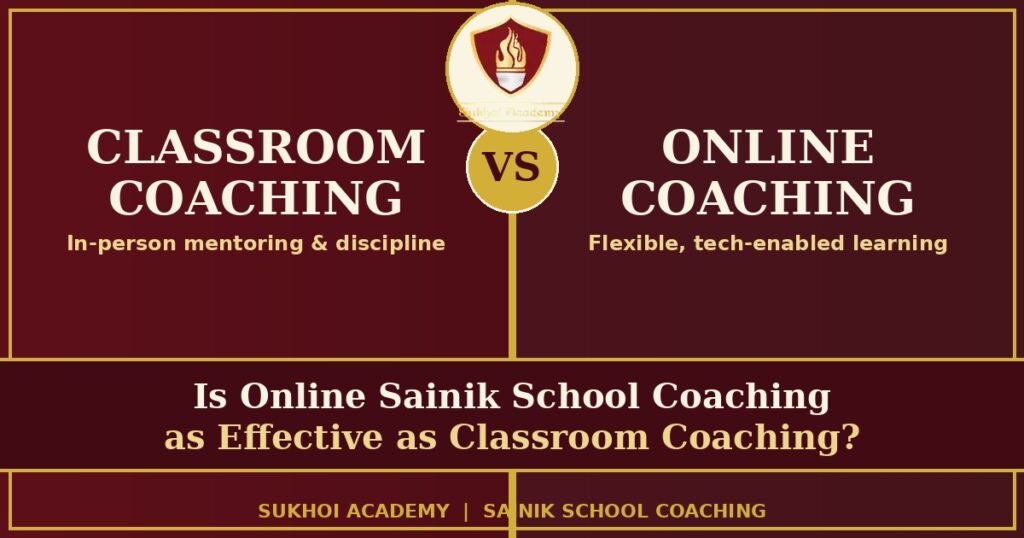
Quick Answer
Yes, online Sainik School coaching can be just as effective as classroom coaching. The result depends on the program, not the screen. A course with live doubt-clearing and weekly mock tests builds real discipline. So does honest progress tracking. A weak online course, or a weak classroom one, gives the same weak result either way.
Why Parents Are Asking This Question?
Sainik School coaching used to mean one thing. A child travelled to a coaching centre every evening after school. That picture has changed. More parents now compare a nearby classroom batch against an online batch running from a laptop at home. Fee bills and commute time vary a lot between the two options. Exposure to specialised faculty varies too. So the question is fair.
This comparison matters most for parents preparing a child for Class 6 or Class 9 entry through the AISSEE. Both entry points test the same core subjects. But age and independence change how well each format works. A ten-year-old preparing for Class 6 entry needs more supervision than a teenager preparing for Class 9 entry.
What Online Sainik School Coaching Offers?
Online sainik school coaching removes the daily commute. It also opens up access to specialised faculty regardless of a student’s city. A child in a small town can join the same live class as a child in a metro. Both get taught by the same subject expert. Recorded sessions let a student revisit a topic as many times as needed. Classroom coaching rarely allows that.
The format also suits families juggling school timings, tuition, and hobby classes. Sessions can run in the early morning or late evening. A missed class is rarely lost for good. The trade-off is real: online coaching leans heavily on a student’s own discipline. Nobody is physically present to notice a distracted mind.
What Classroom Coaching Brings to the Table?
Classroom coaching for Sainik School entrance preparation still has one clear advantage: presence. A faculty member notices body language and catches a wandering eye. They can pull a student aside the same evening a doubt appears. Healthy peer pressure plays a role too. Sitting next to classmates who are working hard tends to lift effort.
Physical classrooms also make it easier to run supervised mock tests under exam-like conditions. That matters for a written exam like the AISSEE. Group discussions and same-day feedback on a test paper are harder to replicate over a screen. It is not impossible with the right online setup, though.
Online vs Classroom Sainik School Coaching: Side-by-Side Comparison
| Factor | Online Coaching | Classroom Coaching |
| Flexibility | High — choose your own time slot | Fixed batch timing |
| Faculty access | Same expert faculty across cities | Limited to local faculty |
| Discipline required | High — self-monitored | Lower — externally monitored |
| Doubt resolution | Live chat/video + recordings | Immediate, in person |
| Cost | Usually lower (no travel, smaller overhead) | Higher (centre, travel, material) |
| Best suited for | Self-motivated students, smaller towns | Younger children needing supervision |
| Mock test environment | Simulated — needs self-discipline | Naturally exam-like |
Does the Coaching Format Change AISSEE Exam Results?
AISSEE exam preparation depends on syllabus coverage, test frequency, and honest evaluation. It depends far less on whether the class happens online or in a room. A student who takes 40 timed mock tests online will usually outscore a student who sat through 40 classroom lectures with no testing at all. The format is just the delivery pipe. The content and testing rigour flowing through it decide the outcome.
Younger children preparing for Class 6 entry often do better with some in-person structure at first. A ten-year-old finds it harder to self-regulate screen time. Students preparing for Class 9 entry are a little older. They tend to adapt to an online format faster and use its flexibility well.
A Simple Way to Decide What Fits Your Child
Start by being honest about your child’s current habits. A child who already completes homework without reminders will do fine online. A child who needs frequent nudging benefits more from a classroom’s built-in structure, at least to begin with.
Next, weigh the practical constraints. Families in smaller towns near Lucknow or Patna often struggle to find specialised Sainik School faculty locally. Online coaching opens up access to better teaching in these cases. Families closer to an established coaching centre may prefer the classroom for its supervised routine.
Finally, check whether the program actually tracks the Sainik School admission process end to end. This covers syllabus completion, mock test scores, physical fitness readiness, and interview preparedness. A coaching format is only as good as the system tracking a child’s readiness against that full timeline.
How Sukhoi Academy Approaches Both Formats?
Sukhoi Academy runs both online and classroom sainik school coaching batches. Both are treated as delivery formats for one rigorous curriculum, not two different products. Every batch follows the same syllabus map and the same weekly testing cycle. Weak areas go through the same faculty-review process regardless of format.
Parents comparing formats can also look at how a coaching provider handles the surrounding milestones — from the sainik school admission process, to knowing the difference between Class 6 vs Class 9 entry, to mapping out career opportunities after Sainik School. A provider that documents all of this clearly, in either format, is usually the safer choice.
Families still comparing Sainik School against other defence-entry routes should also read how Sainik School stacks up against RMS and RIMC before finalising a preparation timeline, since the right entry point affects which coaching format makes sense for the years ahead. Sukhoi Academy also runs dedicated Sainik School coaching in Lucknow and Sainik School coaching in Patna batches, in both online and classroom formats, under the same Sukhoi Academy curriculum.
Conclusion
Online sainik school coaching and classroom coaching are two paths to the same destination. Neither format guarantees a result by itself. What decides the outcome is the coaching provider’s testing rigour, faculty quality, and tracking of the full sainik school admission process. Choose the format that matches your child’s current habits and your family’s practical constraints. Hold any provider to the same standard of structured, test-driven preparation.
Frequently Asked Questions
Is online Sainik School coaching enough to crack the AISSEE?
Yes, when the online program includes regular mock tests, live doubt-clearing sessions, and structured feedback. The exam tests preparation quality, not the medium of instruction.
What is the biggest difference between online and classroom Sainik School coaching?
Supervision. Classroom coaching provides built-in monitoring and peer accountability. Online coaching depends more on the student’s self-discipline, but offers greater flexibility and wider faculty access in return.
Is online Sainik School coaching more affordable than classroom coaching?
Usually, yes. Online coaching removes travel costs and often runs at a lower fee because it avoids centre overheads. The exact difference depends on the coaching provider.
Can a child switch from online to classroom coaching partway through preparation?
Yes, most established coaching providers allow a switch between formats, especially if a student’s early progress shows they need more in-person supervision.
Does Sukhoi Academy offer both online and classroom Sainik School coaching?
Yes. Sukhoi Academy runs both formats on the same curriculum and testing cycle, so a family can choose based on their child’s habits and location rather than a compromise on content quality.