 MON - SAT 09: 00 AM - 06:00 PM (Sunday Closed)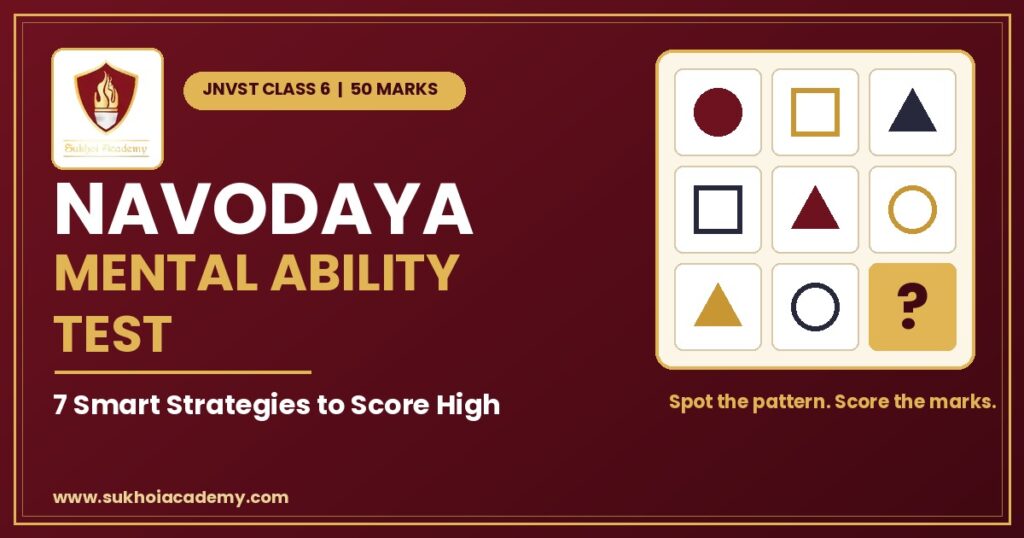
The Navodaya Mental Ability Test is the biggest section of the JNVST, and it carries 50 of the 100 marks. To score high, your child needs three things. First, know the question types. Second, practise daily with a timer. Third, follow a calm plan for the 60-minute slot. This guide explains each step in simple words, so parents and students can start today.
In short, this section rewards clear thinking more than textbook learning. Therefore, a child who solves figure-based puzzles every day will often beat a child who only reads notes. The good news is that this skill can be built by any child with steady practice.
What Is the Navodaya Mental Ability Test?
The Navodaya Mental Ability Test (MAT) is the first section of the Jawahar Navodaya Vidyalaya Selection Test for Class 6 entry. It is a non-verbal test. Therefore, every question uses diagrams, shapes and patterns instead of words. This design lets the Navodaya Vidyalaya Samiti judge a child’s reasoning power, not memory.
The full paper has 80 multiple-choice questions for 100 marks. It runs for two hours, and it has no negative marking. The table below shows how the marks are split across the three sections.
| Section | Questions | Marks | Time | Weightage |
| Mental Ability Test | 40 | 50 | 60 minutes | 50% |
| Arithmetic Test | 20 | 25 | 30 minutes | 25% |
| Language Test | 20 | 25 | 30 minutes | 25% |
| Total | 80 | 100 | 2 hours | 100% |
Each correct answer earns 1.25 marks. Also, sectional minimum marks apply, so a child cannot ignore any section. Please check the latest official notification on the Navodaya Vidyalaya Samiti website for exact cut-offs.
Why the Mental Ability Section Matters Most?
Half of the total marks come from the Navodaya Mental Ability Test section. Moreover, ties in total marks are usually resolved in favour of the higher Mental Ability score. As a result, a strong MAT score protects your child’s final rank.
Furthermore, most Class 5 students have never studied this style of thinking at school. Consequently, this section separates prepared children from unprepared ones. That is why the Navodaya entrance exam is often won or lost here.
Many families therefore look for navodaya coaching that trains this skill in a structured way. Good coaching gives daily drills, mock tests and clear feedback. However, parents can also begin at home with the plan given below.
Question Types in the Mental Ability Test
Knowing the question types is the first step in JNVST preparation. Most papers repeat the same families of questions with new diagrams. The table lists the common ones and the skill each one builds.
| Question Type | What the Child Does | Skill Tested |
| Odd one out | Spots the figure that does not belong | Classification |
| Figure matching | Finds the identical or matching figure | Observation |
| Pattern completion | Picks the piece that completes a design | Visual logic |
| Figure series | Continues a sequence of shapes | Sequence thinking |
| Analogy | Matches figure pairs with the same relation | Relationship reasoning |
| Geometrical figure completion | Completes a partly drawn shape | Spatial sense |
| Mirror imaging | Chooses the correct mirror image | Direction sense |
| Punched hole pattern | Predicts holes after folding and punching | Visualisation |
| Embedded figures | Finds a small shape hidden in a bigger one | Focus |
Note that the exact mix changes slightly each year. Therefore, practise all types equally and avoid favourites.
7 Smart Strategies to Score High in the Navodaya Mental Ability Test
These seven steps work for Class 5 students who are starting fresh. They also help repeaters who want to lift their accuracy. Follow them in order for the best result.
1. Learn Each Question Type Before Chasing Speed
Start with one type at a time. Ask your child to say aloud why an answer is right. Speed comes later, while accuracy comes first. A child who understands the rule will handle any new Navodaya Mental Ability Test diagram with ease.
2. Practise One Type Daily for 20 Minutes
Short daily sessions work better than one long weekend session. For example, use Monday for odd one out and Tuesday for series. Keep a fixed time so the habit sticks. Finish each session with three to five mixed questions.
3. Use the Elimination Method
Most wrong options can be removed in seconds. First, cross out the choices that clearly break the rule. Then compare the two that remain. This method raises accuracy and reduces panic. Since there is no negative marking, an informed guess is always better than a blank.
4. Follow a 60-Minute Time Plan
The section has 40 questions and about 60 minutes, so each question gets roughly 90 seconds. Easy questions need less time than tricky puzzles. Hence, split the hour into three rounds.
- Round one (minutes 1 to 40): solve every easy and medium question, and skip any puzzle that eats more than 90 seconds.
- Round two (minutes 41 to 55): return to the skipped questions and use elimination.
- Final check (minutes 56 to 60): check the OMR sheet for missed or double bubbles.
5. Solve Previous Year Papers and Mock Tests
Real papers show the true difficulty level of the Navodaya Mental Ability Test. Therefore, solve at least one full MAT set every week under exam conditions. A regular JNVST mock test also builds stamina for the two-hour paper. Moreover, it teaches the child to stay calm when a hard question appears.
6. Keep an Error Log
After each test, write down every wrong answer. Note the question type and the reason for the mistake. The reason may be a rushed look, a missed detail or a weak concept. Review this log every Sunday. Within a month, the same mistakes will fade.
7. Train the Eye With Simple Daily Habits
Non-verbal reasoning grows through play. Puzzles, tangrams, paper folding and spot-the-difference games all help. Similarly, drawing shapes and their mirror images builds direction sense. These habits make formal practice feel easier.
A Simple 4-Week Practice Plan
Use this plan as a starting point, and adjust it to your child’s level. This plan prepares your child for the Navodaya Mental Ability Test in four steps, from understanding to speed.
| Week | Focus | Daily Task | Weekly Goal |
| Week 1 | Odd one out, figure matching, analogy | 20 minutes, no timer | 90% accuracy on untimed sets |
| Week 2 | Figure series, pattern completion, figure completion | 25 minutes, light timer | Solve a set in under 20 minutes |
| Week 3 | Mirror imaging, punched hole, embedded figures | 25 minutes, strict timer | Cut careless errors by half |
| Week 4 | Mixed sets and one full mock test | 40 minutes, exam rules | Finish 40 questions in 55 minutes |
Common Mistakes to Avoid:
Even bright children lose marks in the Navodaya Mental Ability Test for avoidable reasons. Watch out for these slips during practice and on exam day.
- Rushing through a diagram without reading the pattern rule.
- Skipping hard types such as punched hole and embedded figures.
- Leaving questions blank even though there is no negative marking.
- Practising only untimed sets and then freezing in the real paper.
- Ignoring Arithmetic and Language, because every section needs its minimum marks.
- Shading the OMR sheet carelessly in the last few minutes.
How Navodaya Coaching Classes Help Your Child Score Higher?
Home practice suits self-driven children. However, many families prefer Navodaya coaching classes for extra support with the Navodaya Mental Ability Test. A good teacher explains the logic behind each figure and sets a fixed routine. In addition, the teacher tracks progress after every test.
Sukhoi Academy offers online and offline batches for Class 6 and Class 9 students. Learners get daily drills, doubt sessions and regular mock tests. Parents in Faridabad and nearby areas can also visit a Navodaya coaching centre for a demo session before they enrol.
Frequently Asked Questions
How many questions are there in the Navodaya Mental Ability Test?
The Mental Ability section has 40 questions worth 50 marks. It is allotted 60 minutes in the JNVST Class 6 paper.
Is there negative marking in the Navodaya Mental Ability Test?
No, there is no negative marking. Therefore, your child should attempt all 40 questions and use elimination on the tough ones.
How can I prepare for the Navodaya Mental Ability Test at home?
Practise one question type daily for 20 to 30 minutes. Then add previous year papers and a weekly mock test. Finally, review every mistake in an error log.
How much time should a child spend on each question?
In the Navodaya Mental Ability Test, aim for about 90 seconds per question. If a puzzle takes longer, skip it and return in the second round.
Is coaching necessary to score high in the Mental Ability section?
Coaching is not compulsory. Even so, this section is not part of the regular school syllabus, so structured guidance and mock tests can save a lot of time.
Final Thoughts: Turn the Biggest Section Into Your Biggest Advantage
The Navodaya Mental Ability Test is not a talent contest. Instead, it is a skill that every child can build. Start with the question types, add timed drills and review every mistake. After a few weeks, the 50-mark section becomes a scoring advantage.
Ready to begin your JNVST preparation? Call +91-8792739294 or write to info@sukhoiacademy.com to book a demo class at Sukhoi Academy, and give your child a confident start.