MON - SAT 09: 00 AM - 06:00 PM (Sunday Closed)
Mental maths tricks help students solve sums in their head, quickly and without rough work. For AISSEE, this skill matters a lot. In the Class 6 paper, Mathematics has 50 questions and carries 150 of the 300 marks. Faster calculation therefore gives students more time for tricky questions and fewer careless slips.
This guide shares nine simple methods, each with a worked example. It also gives a four-week practice plan and a way to track progress through mock tests. Parents can use it at home, and students can try it today.
Why do mental maths tricks matter for AISSEE?
The AISSEE Class 6 paper has 125 questions to be solved in 150 minutes. That works out to roughly one minute per question. Maths questions often need two or three steps, so slow arithmetic quickly eats into the clock.
Strong mental calculation helps in three ways:
- Speed: Students finish easy sums quickly and bank time for harder ones.
- Accuracy: Fewer written steps mean fewer places to slip.
- Confidence: A child who calculates fast stays calm when the timer runs.
Many parents worry that tricks replace understanding. They do not. A trick works only when the child knows why the method is correct. So teach the concept first, then add the shortcut.
Smart AISSEE maths preparation starts with arithmetic fluency. Tables, squares, fractions and percentages form the base. Ratio, averages and mensuration then become much easier. Students can match these skills with the topics listed in the Sainik School syllabus.
Which mental maths tricks work best for entrance exams?
Here are nine mental maths tricks for entrance exams. Each one takes under five minutes to learn. Practise them in order, because the early tricks support the later ones.
Trick 1: Multiply by 5 by halving first
Multiplying by 5 is the same as multiplying by 10 and then halving. For example, 46 × 5 becomes 460 ÷ 2, which is 230. The method is quick for any even number.
Trick 2: Multiply by 9 or 99 using subtraction
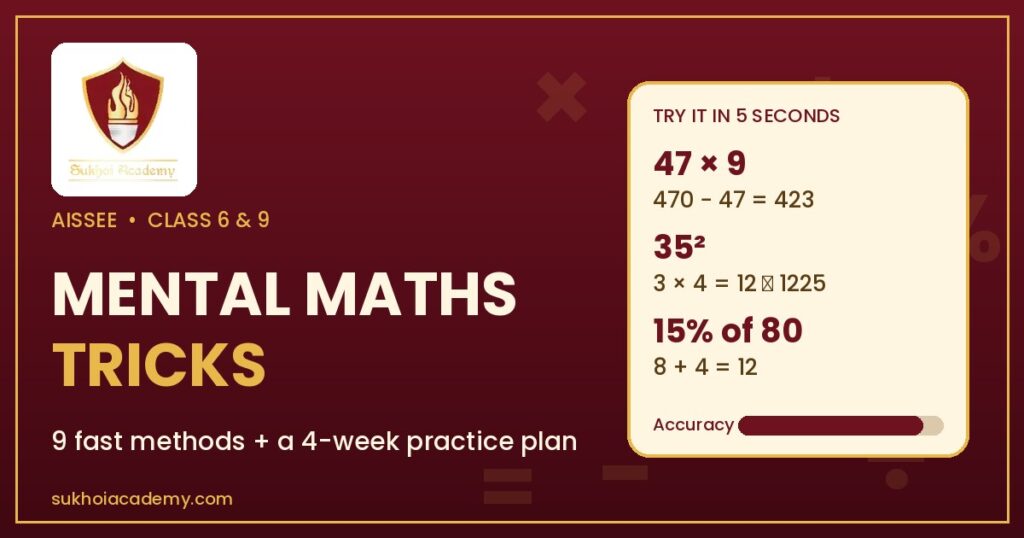
To multiply by 9, multiply by 10 and subtract the number once. For example, 47 × 9 = 470 − 47 = 423. Similarly, 36 × 99 = 3,600 − 36 = 3,564.
Trick 3: Multiply a two-digit number by 11
Add the two digits and place the total between them. For 53 × 11, add 5 and 3 to get 8, so the answer is 583. When the digit total passes 9, carry the extra 1. For instance, 78 × 11 gives 7, then 15, then 8. After carrying, the answer is 858.
Trick 4: Square any number ending in 5
Multiply the tens digit by the next number, then write 25 after it. For 35², multiply 3 × 4 to get 12. The answer is 1,225. Likewise, 65² uses 6 × 7 = 42, so the answer is 4,225.
Trick 5: Round and adjust for addition and subtraction
Round one number to the nearest ten, then fix the difference. For example, 49 + 38 becomes 50 + 38 − 1, which is 87. In the same way, 83 − 29 becomes 83 − 30 + 1, which is 54.
Trick 6: Double and halve for tricky products
Double one number and halve the other. The product stays the same. For example, 25 × 48 becomes 50 × 24, and then 100 × 12. The answer is 1,200.
Trick 7: Break percentages into 10% blocks
First find 10% by moving the decimal point. Then build the rest from that block. To find 15% of 80, take 10% (which is 8) and 5% (which is 4). The total is 12. You can also swap the numbers, because 8% of 25 equals 25% of 8, which is 2.
Trick 8: Use divisibility rules to save time
Divisibility rules let students test a number without long division. A number is divisible by 3 if its digit total is divisible by 3. It is divisible by 9 if the digit total is divisible by 9. For 2,376, the digits add up to 18, so 9 divides it. For 4, check only the last two digits.
Trick 9: Check answers with the unit digit
In multiple-choice papers, the last digit can reject wrong options fast. For 47 × 38, the units give 7 × 8 = 56, so the answer must end in 6. The real answer is 1,786. If an option ends in any other digit, drop it.
Several of these shortcuts appear in books on Vedic maths tricks. However, the label does not matter. What matters is that the child can explain each step and use it under time pressure.
How can kids practise mental maths every day?
Mental maths tricks for kids work best in short, daily bursts. Fifteen focused minutes beat one long session on Sunday. This four-week plan keeps practice simple.
| Week | Focus | Daily 15-minute task |
| Week 1 | Tables and squares | Recite tables up to 20 and squares up to 25, then take a 5-minute oral quiz |
| Week 2 | Tricks 1 to 5 | Learn one trick every two days and solve 10 sums with it |
| Week 3 | Tricks 6 to 9 and percentages | Solve timed sets of 15 sums in 10 minutes |
| Week 4 | Mixed speed drills | Solve 20 mixed sums in 15 minutes, then check accuracy |
Four habits make the plan work better:
- Start every session without a pencil, then check on paper.
- Use a timer, so the child gets used to exam pressure.
- Ask the child to say each step aloud.
- Revise common fractions and their percentages every week.
Over time, these fast calculation tricks become automatic. As a result, students improve calculation speed without feeling rushed.
How do AISSEE mock tests improve speed and accuracy?
Practice alone is not enough, because students also need to measure it. An AISSEE mock test shows how each trick performs under real exam pressure. It also reveals which topics still slow the child down.
After every mock test, track three numbers:
- Speed: How many Maths questions the child attempted per minute.
- Accuracy: Correct answers divided by questions attempted.
- Time left: Minutes remaining after the Maths section.
Here is an example. A student attempts 44 of 50 Maths questions and gets 38 right. Accuracy is 38 ÷ 44, which is about 86%. A sensible target for the next test is 90%. That goal is clear and measurable.
How can students turn weak areas into strengths?
Follow these five steps after each mock test:
- Sort every wrong answer into one of four types: concept gap, calculation slip, time pressure, or misread question.
- Record each calculation slip in an error notebook for competitive exams.
- Pick the trick that would have prevented the slip, and drill ten sums with it.
- Retest the same topic in a timed set after three days.
- Compare the new mock score with the last one, and note the change in a simple table.
As a simple rule, treat any subject with accuracy below 80% as a weak subject. For example, if Maths accuracy is 78% but Reasoning is 92%, Maths needs extra time this week. Meanwhile, the strong subject only needs light revision.
Time management also needs a rule. On the first pass, spend no more than 90 seconds on one Maths question. If the answer does not come, mark it and move on. Then return to it after finishing the easier sums.
What mistakes should students avoid?
Some habits waste effort even when the child works hard. Watch out for these:
- Learning all nine tricks in one day, which leads to confusion.
- Using a trick without knowing why it works.
- Practising untimed sums only, which hides real speed.
- Guessing wildly, even though wrong answers lose marks.
- Skipping revision, so last week’s tricks fade.
How can parents and teachers help?
Parents do not need to teach every trick. Instead, they can ask the child to explain one trick at dinner. They can also time a short drill and celebrate small gains in accuracy.
Some families prefer expert guidance on mental maths tricks and other topics. Structured Sainik School coaching adds teacher feedback, timed tests and doubt clearing. This support helps when a child keeps repeating the same mistakes.
Frequently asked questions
What are mental maths tricks?
Mental maths tricks are shortcuts that help you calculate in your head. They use patterns, such as rounding, halving or digit totals, to cut the number of steps.
Which mental maths tricks are best for Class 6 students?
Start with tricks 1 to 5. They need only tables and simple addition. Once these feel easy, add the percentage and divisibility tricks.
How long should a child practise mental maths daily?
Fifteen to twenty minutes is enough for most children. Short, regular sessions work better than long, irregular ones.
Are Vedic maths tricks useful for AISSEE?
Yes, many of them speed up calculation. However, students should learn the reason behind each method first. Otherwise, they may use it wrongly in a new question.
How can students improve calculation speed quickly?
Memorise tables and squares, practise one trick at a time, and use a timer. Then take regular mock tests to check progress.
Can students use a calculator in the AISSEE?
No, calculators are not allowed in the exam hall. Students must solve every sum by hand, which is why mental calculation matters.
Final thoughts
Mental maths tricks are a skill, and every skill grows with small daily steps. Pick one trick today and practise it for ten sums. Then take one timed mock test this week and note your accuracy. Within a month, you will see faster work and fewer careless errors.