 MON - SAT 09: 00 AM - 06:00 PM (Sunday Closed)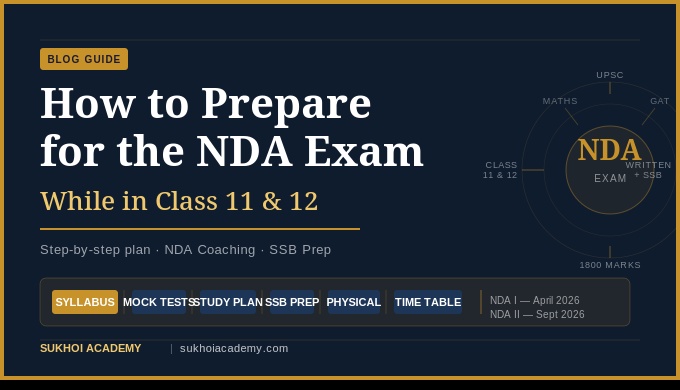
If you are in Class 11 or 12 and dreaming of joining the Indian Armed Forces, you are already ahead of most aspirants. The National Defence Academy (NDA) exam is one of India’s most competitive defence entrance tests — but it is also one that rewards early and structured preparation. Students who begin their journey in Class 11 have a genuine advantage over those who start late. In this guide, we walk you through a clear, step-by-step plan to prepare for the NDA exam while managing your school studies at the same time.
Step 1 — Understand the NDA Exam Structure First
Before you open a single textbook, understand exactly what you are preparing for. The NDA written exam consists of two papers conducted by UPSC.
Paper I — Mathematics carries 300 marks and tests topics from Class 11 and 12 level Maths. Paper II — General Ability Test (GAT) carries 600 marks and covers English, Physics, Chemistry, History, Geography, Political Science, and Current Affairs.
Additionally, candidates who clear the written exam appear for the SSB Interview, which carries 900 marks. The total selection score is 1800 marks. Understanding this structure helps you allocate your preparation time correctly from day one.
Step 2 — Check Your Eligibility Early
Many students waste months preparing only to discover they do not meet the eligibility criteria. Confirm the following before you begin:
- You must be between 16.5 and 19.5 years of age at the time of application
- For the Army wing, any stream in Class 12 is acceptable
- For the Air Force and Navy wings, you must have Physics and Mathematics as subjects in Class 12
- Students appearing in Class 12 board exams are also eligible to apply
If you are in Class 11 with the Air Force or Navy in mind, ensure you are studying Physics and Mathematics right now — there is no shortcut here.
Step 3 — Build Your Foundation in Class 11
Class 11 is the most valuable year for NDA preparation. Here is why — nearly 60% of the NDA Mathematics paper is based on Class 11 topics. Similarly, the GAT science section heavily draws from Class 11 Physics and Chemistry. Therefore, paying serious attention in school during Class 11 directly strengthens your NDA preparation.
Focus areas in Class 11:
- Mathematics — Algebra, Trigonometry, Sets and Functions, Coordinate Geometry, Statistics and Probability
- Physics — Laws of Motion, Work and Energy, Thermodynamics, Waves
- Chemistry — Atomic Structure, Chemical Bonding, States of Matter
- English — Grammar rules, reading comprehension, vocabulary building
This is also the right time to enroll in a structured NDA coaching programme. Starting coaching in Class 11 gives you a full year of guided preparation before your board exams demand attention in Class 12. Many students who join NDA coaching at this stage complete their entire written exam syllabus well before the actual exam date.
Step 4 — Create a Realistic Daily Study Schedule
Discipline is at the core of every successful NDA aspirant’s routine. However, trying to study 10 hours a day while attending school is neither practical nor sustainable. Instead, aim for a focused 3 to 4 hour daily study routine outside school hours.
Sample daily schedule for a Class 11 or 12 student:
| Time | Activity |
|---|---|
| 6:00 AM – 7:00 AM | Physical training — running, yoga, or exercise |
| School hours | Pay full attention in Maths and Science classes |
| 5:00 PM – 6:00 PM | NDA Mathematics — one topic per session |
| 6:30 PM – 7:30 PM | GAT preparation — English or General Knowledge |
| 8:30 PM – 9:30 PM | Revision or current affairs reading |
| Weekend | Full-length mock test + error analysis |
Consistency matters far more than intensity. Studying 3 focused hours daily for 12 months beats cramming 10 hours for 2 months every single time.
Step 5 — Master the Mathematics Paper Strategically
Mathematics is the section where most aspirants either win or lose the NDA exam. The paper has 120 questions for 300 marks, with negative marking of 0.83 per wrong answer. Speed and accuracy together determine your score.
High-priority topics for NDA Maths:
- Algebra and Quadratic Equations
- Trigonometry — identities, equations, inverse functions
- Differential Calculus and Integral Calculus
- Matrices and Determinants
- Probability and Statistics
- Vector Algebra
- Analytical Geometry — 2D and 3D
Start with the topics you already study in school. Moreover, practice at least 20 to 30 Maths questions daily — not just theory revision. The NDA Maths paper is time-pressured, so solving problems fast and accurately is a skill you must develop over months, not days.
A good NDA coaching programme will guide you through these topics in the right sequence, ensuring you cover the entire syllabus without gaps before exam day.
Step 6 — Prepare the GAT Paper Section by Section
The General Ability Test carries twice the marks of the Maths paper, yet many students underestimate it. Break the GAT into manageable parts and tackle each section systematically.
English (200 marks)
Focus on grammar rules, spotting errors, sentence correction, antonyms, synonyms, and comprehension passages. Read an English newspaper daily — even 20 minutes a day builds vocabulary and reading speed over time.
General Knowledge (400 marks)
This section covers six subjects. Prioritize them in this order:
- Physics — closely aligned with your Class 11 and 12 syllabus
- Current Affairs — read a newspaper or follow a reliable news app daily
- History — focus on Modern Indian History and World Wars
- Geography — physical, Indian, and world geography
- Political Science — Indian Constitution, governance, defence policy
- Chemistry — basic concepts are sufficient; deep study is not required
Step 7 — Start Physical Fitness Training From Day One
The SSB Interview includes a medical examination with strict physical standards. Furthermore, the overall culture of NDA selection expects physically fit candidates. Do not leave fitness preparation for later.
Minimum physical standards to work towards:
- Running 1.6 km in under 7 minutes
- Minimum height of 157 cm (162.5 cm for Air Force)
- Good eyesight — avoid excessive screen time; practice eye care habits
- No flat feet, knock knees, or postural defects
Include 30 to 45 minutes of physical training in your daily routine from Class 11 itself. Running, swimming, push-ups, and yoga are all excellent starting points. Students enrolled in residential NDA coaching centres benefit greatly here because physical training is built into the daily programme alongside academics.
Step 8 — Use the Right Study Material
Choosing the right books saves you months of wasted effort. Here are the recommended resources:
For Mathematics:
- R.D. Sharma — Class 11 and 12 Maths
- R.S. Aggarwal — Quantitative Aptitude
- Previous year NDA Maths papers (last 10 years minimum)
For GAT — English:
- Wren and Martin — High School English Grammar
- Previous year NDA English papers
For GAT — General Knowledge:
- NCERT books — Class 9 to 12 for Science, History, Geography, Political Science
- Manorama Yearbook or Pratiyogita Darpan for current affairs
- Lucent’s General Knowledge
Above all, previous year question papers are the single most valuable resource. Solve at least the last 10 years of NDA papers — they reveal recurring patterns and help you understand exactly where to focus.
Step 9 — Take Mock Tests and Analyse Every Mistake
Studying without testing is like training without matches. From the very beginning of your preparation, take mock tests regularly.
Mock test schedule recommendation:
- Class 11: One sectional test per week (Maths or GAT separately)
- Class 12 (first half): One full-length mock test every two weeks
- Class 12 (final months before exam): One full-length mock test every week
More importantly, never move on after a mock test without analysing every wrong answer. Understanding why you got a question wrong is more valuable than answering 50 more questions without reflection.
Quality NDA coaching programmes include structured mock tests with detailed performance analysis. This feedback loop is one of the strongest reasons why coached candidates outperform self-study aspirants in NDA results.
Step 10 — Prepare for the SSB Interview Alongside Written Exam
Many students make the mistake of thinking about the SSB only after clearing the written exam. This is a costly error. SSB preparation is a long process that builds gradually over time.
What the SSB evaluates:
- Officer Intelligence Rating (OIR) — logical reasoning and problem-solving
- Picture Perception and Description Test (PPDT)
- Group Discussion and Group Tasks
- Personal Interview
- Psychological Tests — TAT, WAT, SRT, SD
Start building the following qualities from Class 11 itself — leadership in school activities, communication skills, reading habits, current affairs awareness, and emotional stability under pressure. Joining a coaching centre that offers NDA coaching with integrated SSB preparation gives you a structured path to develop these qualities alongside your written exam preparation.
Step 11 — Balance Board Exams and NDA Preparation in Class 12
Class 12 is where most students feel the pressure of two competing priorities — board exams and NDA preparation. However, the good news is that both share a very similar syllabus, especially in Mathematics, Physics, and Chemistry.
Practical tips for balancing both:
- Give priority to board exams from January to March — NDA preparation does not stop but slows slightly
- Use your board exam preparation to simultaneously strengthen your NDA syllabus
- After board exams, shift to full-time NDA focus — mock tests, revision, and SSB preparation
- NDA I exam typically falls in April — this timing aligns well with students finishing boards
Students who start early in Class 11 have the luxury of slowing down during boards without losing momentum. This is another strong reason why early NDA coaching gives aspirants a significant edge over last-minute starters.
Conclusion
Preparing for the NDA exam while in Class 11 and 12 is entirely achievable with the right plan, the right resources, and consistent daily effort. Start by understanding the exam pattern. Build your foundation in Class 11. Follow a disciplined daily schedule. Master Mathematics and GAT systematically. Train physically from day one. And take mock tests regularly to measure your progress.
Most importantly, do not try to do this alone when expert guidance is available. Joining a trusted NDA coaching programme gives you structured preparation, experienced mentors, mock SSB sessions, and a competitive environment that pushes you to perform at your best. The dream of wearing the uniform is absolutely within reach — start today, stay consistent, and let your hard work do the talking.