MON - SAT 09: 00 AM - 06:00 PM (Sunday Closed)
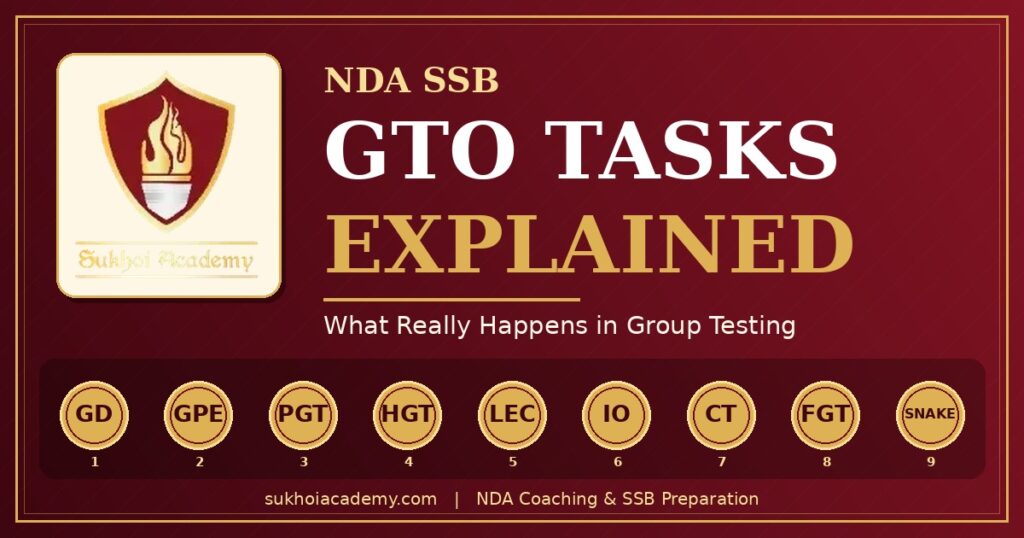
NDA SSB GTO tasks are the group tests that the Group Testing Officer (GTO) conducts during the SSB, usually on Days 3 and 4. Nine tasks make up the list, from a simple group chat to a timed obstacle race. Together, they show how you plan, lead, cooperate and stay calm under pressure.
Many NDA aspirants fear this stage more than the written exam. However, the GTO tasks are not tricks. They follow a clear pattern, and you can prepare for each one. This guide explains every task, the qualities behind it and the habits that help you score.
What Are GTO Tasks in the SSB?
The Group Testing Officer watches a group of candidates solve problems together. Also, each candidate wears a chest number. The officer notes how every person speaks, plans, acts and reacts. In contrast to the written exam, no answer is marked right or wrong. Instead, the officer looks for Officer Like Qualities (OLQs) in your behaviour.
Strong SSB interview preparation starts with this idea. Instead of memorising answers, you must show real behaviour in group tasks. Practice, fitness and a team mindset matter far more.
Where GTO Tasks Fit in the 5-Day SSB Process
In total, the SSB runs for five days. Day 1 covers screening through the OIR test and PPDT. Next, Day 2 brings the psychology tests. Days 3 and 4 are for the GTO tasks. Finally, Day 5 ends with the conference. The personal interview is scheduled separately for each candidate. For a full breakdown, read our guide to the SSB interview 5-day process.
The NDA SSB GTO tasks sit at the heart of this schedule. However, exact scheduling can differ between selection centres. Therefore, always follow the dates on your call-up letter.
The 9 NDA SSB GTO Tasks at a Glance
The table below summarises each task. Boards may vary the order, timing and obstacle layout. Treat these details as typical, not fixed.
| Task | Typical format | What it tests |
| 1. Group Discussion (GD) | Two talks of about 20 minutes: a debate topic, then a social issue | Expression, reasoning, listening |
| 2. Group Planning Exercise (GPE) | Map-based problem; about 10 minutes alone, then about 20 minutes as a group | Planning, organising ability |
| 3. Progressive Group Task (PGT) | Group clears three or four obstacles in sequence with rope, plank and log | Cooperation, initiative |
| 4. Half Group Task (HGT) | Group splits into two halves; each half handles one obstacle | Influence in a small team |
| 5. Lecturette | Pick one of four topics; about 3 minutes to prepare, 3 minutes to speak | Knowledge, confidence, fluency |
| 6. Individual Obstacles (IO) | Ten obstacles in about 3 minutes | Courage, stamina, determination |
| 7. Command Task (CT) | You lead two helpers through one obstacle within a time limit | Leadership, speed of decision |
| 8. Final Group Task (FGT) | One last group obstacle with the same rules as the PGT | Teamwork under fatigue |
| 9. Snake Race | Teams race through obstacles while carrying a rolled-up tent | Team spirit, liveliness, stamina |
The 15 Officer Like Qualities Behind Every Task
In the NDA SSB, every task maps back to the same 15 Officer Like Qualities. They sit under four factors. The GTO sees you in action, so group tasks give direct evidence of how you work with others.
| Factor | Qualities |
| I. Planning and Organising | Effective intelligence, reasoning ability, organising ability, power of expression |
| II. Social Adjustment | Social adaptability, cooperation, sense of responsibility |
| III. Social Effectiveness | Initiative, self-confidence, speed of decision, ability to influence the group, liveliness |
| IV. Dynamic | Determination, courage, stamina |
No single quality decides the result. Instead, assessors compare your behaviour across all tests and all days. Therefore, consistency counts more than one brilliant moment.
Task-by-Task Guide: What Happens and How to Score
1. Group Discussion (GD)
The GD usually has two rounds of about 20 minutes each. First, the group picks one topic from two options. Next, the group discusses a social issue. The officer does not expect a final conclusion. Instead, the officer watches who listens, who contributes and who respects others.
- Speak early, but never interrupt anyone.
- Back each point with one clear fact or example.
- Invite quiet members into the talk with a polite question.
2. Group Planning Exercise (GPE)
The GPE gives the group a map and a problem to solve. The problem usually comes with limits on time and resources. First, you plan alone for about 10 minutes. Next, the group merges its ideas in a discussion of around 20 minutes. Finally, one candidate presents the group plan to the GTO.
- Read the map and the problem twice before you write.
- Write a short, ordered plan with clear priorities.
- Defend your plan with logic, then accept a better idea gracefully.
3. Progressive Group Task (PGT) and Half Group Task (HGT)
In the PGT, the group crosses three or four obstacles in sequence. You get only simple material, such as rope, a plank, a wooden log and a load. Because time is short, the group must plan, share jobs and keep moving. In the HGT, the group splits into two halves. Each half then tackles one obstacle. The smaller team makes your own contribution easier to see.
- Offer short, clear suggestions instead of long speeches.
- Read the rules before you act, because a breach wastes time.
- Help carry the load even when the group rejects your idea.
4. Lecturette
For the lecturette, you choose one of four topics. You get about three minutes to organise your thoughts and three minutes to speak. Topics often cover current affairs, general knowledge and everyday issues.
A daily reading habit helps a lot here. Our guide to current affairs for defence aspirants shows a 20-minute routine that builds topic knowledge quickly.
- Use a simple structure: opening, three points, closing.
- Speak slowly and look at your audience.
- Stop on time with a firm closing line.
5. Individual Obstacles (IO)
The Individual Obstacles course has ten obstacles, and you get about three minutes in total. Also, each obstacle carries points, and harder ones carry more. You may attempt them in any order, and you may repeat them if time remains. This task tests courage, stamina and determination.
- Build upper-body strength and balance well before the SSB.
- Start with obstacles you can clear safely, then try harder ones.
- Never attempt a risky jump that you have not practised.
6. Command Task (CT)
Here, you become the commander. You pick two helpers, plan quickly and clear an obstacle within a time limit. Meanwhile, the GTO observes your leadership. Command is not about shouting. It is about clear orders, fair use of your helpers and calm decisions.
- Make a quick plan and share it with both helpers.
- Use each helper’s strengths.
- Admit a mistake and adjust fast.
7. Final Group Task (FGT) and Snake Race
The FGT is the last group obstacle, and it follows the same rules as the PGT. By now, fatigue shows. The officer checks whether your teamwork stays steady. The Snake Race, also called the Group Obstacle Race, works differently. Teams race through a set of obstacles while carrying a rolled-up tent, the “snake”. The group must not drop or fold it, and at least three candidates must hold it at every obstacle.
Energy and team spirit count most here. Cheer your group, help weaker members and stay positive after a mistake.
7 Habits That Help You Score Well in GTO Tasks
- Be a team player first. Help the group before you chase attention.
- Speak clearly and briefly. Short, sensible points earn more respect than long speeches.
- Stay physically fit. Run, do pull-ups and practise balance work for several months before the SSB.
- Read daily. A newspaper habit builds content for the GD and the lecturette.
- Practise with friends. Mock discussions and planning exercises give you honest feedback.
- Stay calm after errors. Everyone slips, but the GTO notices how you recover.
- Be yourself. Faked behaviour is hard to hold for four days.
A steady daily routine also builds the calm that officers notice. Try the discipline habits for students that we shared earlier on this blog.
Common GTO Mistakes to Avoid
- Dominating the group or talking over others.
- Staying silent for the whole task.
- Arguing for your idea after the group rejects it.
- Ignoring safety rules or instructions.
- Giving up after one failed attempt at an obstacle.
- Memorising speeches instead of thinking on your feet.
Notably, over-acting is as risky as under-acting. A balanced, honest approach wins.
How NDA Coaching Prepares You for Group Testing
The written exam gets you to the SSB. After that, group testing decides how far you go. Therefore, smart NDA preparation covers both stages together.
Good NDA coaching adds mock GDs, planning exercises, lecturette practice and fitness routines to the classroom. Sukhoi Academy’s NDA coaching combines written-exam preparation with SSB-focused guidance, so students build their OLQs early.
Choosing the right defence exam coaching matters because SSB skills take months to build. Look for mock GTO sessions, fitness guidance and regular feedback from trained mentors. If you are starting from scratch, read how to get into NDA for the full roadmap, from eligibility to final selection.
FAQs on NDA SSB GTO Tasks
What are GTO tasks in the SSB?
GTO tasks are group and individual tests run by the Group Testing Officer during the SSB. They include discussions, planning exercises, obstacle tasks and a lecturette. The officer uses them to assess Officer Like Qualities such as cooperation, initiative and courage.
How many GTO tasks are there in the NDA SSB?
Nine tasks are commonly listed: GD, GPE, PGT, HGT, lecturette, individual obstacles, command task, FGT and the snake race. However, the order and details can differ between boards. Follow the instructions you receive on the day.
On which days are GTO tasks held?
GTO tasks usually take place on Days 3 and 4 of the five-day SSB. Selection centres may adjust the schedule, so always check your call-up letter.
Do I need to be a leader to clear GTO tasks?
No. Leadership matters, but the officer also values cooperation, sense of responsibility and adaptability. A cooperative team member with clear ideas can score well. The board looks at all qualities together.
How can I prepare for GTO tasks at home?
Practise mock group discussions with friends, read a newspaper daily and give timed three-minute talks. In addition, build strength, balance and stamina through regular exercise. Finally, learn the task formats so nothing surprises you.
Does SSB coaching help with GTO tasks?
Yes, it can. Structured SSB coaching gives you mock GTO sessions, feedback and fitness guidance. As a result, you learn to spot your weak OLQs and fix them before the real board.
Final Thoughts
NDA SSB GTO tasks look tough, yet they reward simple, honest behaviour. Plan with the group, lead when asked, speak with clarity and push through the physical tasks. Start practising early, stay consistent and keep your focus on team success. For official exam notices, check the UPSC website.
Ready to prepare with expert guidance? Explore our NDA coaching programmes and take the next step towards the uniform.