 MON - SAT 09: 00 AM - 06:00 PM (Sunday Closed)
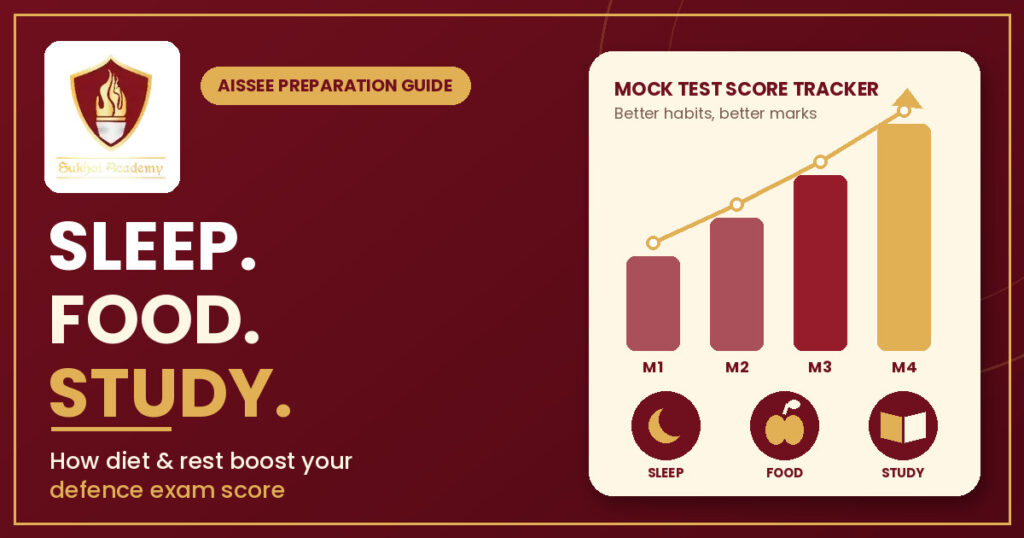
Quick answer: Diet and sleep for exam preparation matter as much as study hours. Children aged 6 to 12 need 9 to 12 hours of sleep, and teenagers need 8 to 10 hours. Add a protein-rich breakfast, regular meals and enough water. Then focus, memory and accuracy improve.
Many parents tell us the same thing. Their child studies for hours, yet the mock test score barely moves. However, the problem is often not the syllabus. It is a tired brain and an empty stomach. This guide shows how food and rest turn study time into marks. It also gives a simple plan that students and parents can start today.
Why is diet and sleep for exam preparation so important?
The brain needs fuel and rest to learn. Sleep stores what a child studied during the day. Food gives the energy to concentrate for long hours. Without both, even a bright student makes careless mistakes. As a result, marks fall for no clear reason.
Consider the paper itself. The AISSEE Class 6 paper runs for 150 minutes, and the Class 9 paper runs for 180 minutes. The exam also starts in the afternoon, so a child must stay sharp after a full morning. Therefore, rest and meals are part of your AISSEE preparation, not a side topic.
The same rule applies to every defence exam. Cadets and officers follow fixed sleep and meal timings for a reason. Good habits protect the mind under pressure, so we teach them early at Sukhoi Academy.
How many hours should a student sleep?
The American Academy of Sleep Medicine has published clear numbers. Sleeping the recommended hours is linked with better attention, learning and memory, according to its consensus statement on children’s sleep. Use the table below as a guide.
| Age group | Recommended sleep per 24 hours | Matches which AISSEE class? |
| 6 to 12 years | 9 to 12 hours | Class 6 aspirants (10 to 12 years) |
| 13 to 18 years | 8 to 10 hours | Class 9 aspirants (13 to 15 years) |
So, how many hours should a student sleep during preparation? Aim for the middle of the range, not the lowest number. A Class 6 child should sleep at least 9 hours. A Class 9 student should sleep at least 8 hours, and 9 is even better.
How does sleep improve memory and exam performance?
Sleep is when the brain sorts and stores new information. For example, a student who studies Maths in the evening and sleeps well remembers more the next morning. In contrast, a student who stays up late loses part of what was learnt.
- Better memory: Sleep helps lock in formulas, vocabulary and facts.
- Sharper attention: A rested child reads each question fully, so silly errors drop.
- Calmer mood: Good sleep lowers exam stress and irritability.
- Faster thinking: Reasoning and Maths questions take less time when the mind is fresh.
Never plan an all-night study session before a mock test. Instead, finish revision early and protect bedtime. One good night often beats three extra hours of tired reading.
What should students eat during exam preparation?
A healthy diet for students does not need costly food. It needs balance. Each meal should include some protein, some whole grains and some fruit or vegetables. These brain foods for students give steady energy instead of a quick spike and crash.
| Meal | Good choices | Why it helps |
| Breakfast | Poha with peanuts, vegetable upma, idli-sambar, eggs, paratha with curd, milk and a banana | Protein and slow-release energy keep focus steady until lunch |
| Lunch | Roti or rice, dal, a vegetable, curd or salad | A balanced plate prevents the afternoon slump |
| Evening snack | Roasted chana, fruit, nuts, sprouts, a glass of milk | Refuels the brain before the evening study block |
| Dinner | Light khichdi, roti with sabzi and dal, soup | A light meal helps the child fall asleep faster |
Also, drink water through the day. In fact, even mild thirst can tire a child. Keep a bottle on the study table, and sip often.
Which foods and habits should students avoid?
Some habits quietly lower marks. Fortunately, parents can spot most of them quickly.
- Skipping breakfast: Hunger in the first class makes it hard to concentrate.
- Energy drinks and too much tea or coffee: They can delay sleep and raise restlessness. Children should avoid energy drinks.
- Sugary snacks and packaged food: They give a short burst of energy, followed by a crash.
- Heavy, oily dinners: They make sleep uncomfortable.
- Late-night screens: Phones and TV push bedtime later and make sleep lighter. Our guide on screen time and defence exam focus explains how to fix this.
What does a daily study routine for exams look like?
A fixed study routine for exams removes daily arguments. The child simply follows the clock. Here is a sample day for an AISSEE aspirant that puts diet and sleep for exam preparation first. Adjust the timings to your school hours.
| Time | Activity | Why it works |
| 6:00 am | Wake up, drink water, 20 to 30 minutes of exercise | Wakes up the body and mind |
| 7:15 am | Healthy breakfast | Fuels the morning |
| 4:30 pm | Snack, then a short break | Restores energy after school |
| 5:00 to 7:00 pm | Two study blocks with a 10-minute break | Short blocks improve focus |
| 7:30 pm | Light dinner | Leaves time to digest |
| 8:00 pm | Quick revision or reading, no screens | Prepares the mind for sleep |
| 9:00 pm (Class 6) or 9:45 pm (Class 9) | Lights out | Protects the recommended sleep hours |
How can parents support healthy exam habits?
Children copy what they see. When parents keep a calm home, children relax too. In addition, a few small actions make a big difference.
- Keep meal and bedtime hours fixed, even on holidays.
- Pack healthy snacks instead of buying packaged ones.
- Switch off the TV and put phones away one hour before bed.
- Praise effort and routine, not only marks.
- Watch for warning signs, such as constant tiredness, headaches or loss of appetite.
If these signs continue, speak to your family doctor. Good diet and sleep for exam preparation should leave a child energetic, not exhausted. This guide offers general wellness advice. For allergies, medical conditions or special diets, always check with your child’s doctor.
How can mock tests show whether your routine works?
Mock tests are the best scoreboard for your habits. Moreover, they show whether better sleep and food actually raise marks. Follow this simple method, which builds on our guide to AISSEE mock test analysis.
- Log the basics. After each mock, note sleep hours, breakfast and the score.
- Check accuracy. Divide correct answers by questions attempted for each section.
- Check time. Both papers give about 1.2 minutes per question, so note the minutes left at the end.
- Find the weak subject. Mark any section below 80% accuracy as a weak area.
- Compare with your habits. Look for patterns, such as more careless errors after late nights.
- Repair and retest. Fix the weakest topic for a week, then retake a short test.
Here is an illustrative example. Meera sleeps 7 hours before Mock 3 and attempts 44 Maths questions with 34 correct. Her accuracy is about 77%. After a week of 9-hour nights, she attempts 44 again and gets 39 right. Her accuracy rises to about 89%. The syllabus did not change. Her rest did.
How do you build a healthy exam routine in 7 days?
Do not change everything at once, because small steps stick better. Follow this plan.
- Write down current sleep, meal and study timings (day 1).
- Then fix a wake-up time and keep it every day (day 2).
- Add a protein-rich breakfast on day 3.
- By day 4, move bedtime 15 minutes earlier, and repeat every two days until you reach the target.
- Replace one packaged snack with fruit, nuts or chana on day 5.
- Also start a screen-free hour before bed on day 6.
- Finally, review the week on day 7 and take a short timed test.
What should students do in the last week before the exam?
Keep the same routine. Do not try new foods or new timings. Instead, sleep on time, and eat a light, familiar dinner the night before. On exam day, have a proper breakfast and a light lunch well before the afternoon paper. Carry water if the exam centre allows it. For a full countdown, read our plan for the final 30 days before an entrance exam.
Frequently asked questions
How many hours should a student sleep during exam preparation?
Children aged 6 to 12 need 9 to 12 hours of sleep. Teenagers aged 13 to 18 need 8 to 10 hours. So, do not cut sleep to add study hours. Doing so lowers memory and focus.
What is the best breakfast before a competitive exam?
Choose a familiar meal with protein and whole grains. Poha with peanuts, idli-sambar, eggs with roti or paratha with curd all work well. Avoid trying new or very oily food on exam day.
Does skipping meals affect exam performance?
Yes. Hunger reduces focus and raises tiredness. However, regular meals keep energy steady across long study blocks and long papers.
Is it okay to study late at night for AISSEE?
It is not a good idea. Late nights cut sleep, and sleep helps memory. Instead, a child learns more by studying earlier and sleeping on time.
Are energy drinks safe for children before exams?
No. Energy drinks can disturb sleep and increase restlessness. Water, milk, fruit and a balanced meal are better choices.
Can coaching help build healthy study habits?
Yes, because a structured timetable, weekly tests and regular feedback keep a child on track. Our Sainik School coaching programme combines live classes, mock tests and performance analysis to build these habits.
Final thoughts: rest well, eat well, score well
Study hours matter, but they work best with good food and sleep. Start with one small change today, such as an earlier bedtime or a better breakfast. Then track the result in your next mock test. Over time, strong diet and sleep for exam preparation will show up in your score, your confidence and your calm.