 MON - SAT 09: 00 AM - 06:00 PM (Sunday Closed)
Military terms for defence aspirants are the everyday words of the armed forces, such as battalion, recce, sortie and chain of command. This guide explains 50 of them in plain English. Each meaning is short, so you can learn five terms a day and finish in ten days.
Do you freeze when a quiz asks the difference between a regiment and a battalion? You are not alone. Many students and parents meet these words for the first time during preparation. The good news is that anyone can learn them quickly, because the method is simple.
Why Do Military Terms Matter for Defence Exam Preparation?
Learning army terms in English helps in three ways. First, it builds your general awareness for written papers. Second, it makes SSB interview conversations easier, because you understand what officers say. Third, it gives young students a head start on the culture of a Sainik School or the NDA.
Strong defence exam preparation is not only about maths and reasoning. It also means knowing how the forces work. In fact, children enjoy these words because they feel like a secret code.
How Are the Indian Armed Forces Organised? (Terms 1–10)
First, start with structure. These terms tell you who belongs to which group and how big each group is. The sizes below are approximate, because they vary by type of unit.
1. Armed Forces – The Army, Navy and Air Force of India together. They defend the country on land, at sea and in the air.
2. Tri-Services – A short word for all three services working as one team. A joint exercise is called a tri-service exercise.
3. Platoon – A small group of about 30 soldiers, led by a junior officer.
4. Company – A group of roughly 100 to 120 soldiers, made up of several platoons. A Major usually commands it.
5. Battalion – A group of about 800 to 1,000 soldiers, made up of several companies. A Lieutenant Colonel usually commands it.
6. Regiment – In the Indian Army, a regiment is a family of battalions that share a name, a history and traditions. The Rajput Regiment and the Sikh Regiment are two examples.
7. Brigade – A formation of three or more battalions, led by a Brigadier.
8. Division – A formation of several brigades under a Major General. It holds roughly 10,000 to 15,000 soldiers.
9. Corps – A large formation of two or more divisions, led by a Lieutenant General.
10. Command – The highest regional headquarters of the Army. Western Command and Northern Command are examples.
What Are the Main Ranks and Roles in the Armed Forces? (Terms 11–20)
Indian Army ranks confuse many learners. Remember this simple order instead. Commissioned officers come first, then JCOs, then NCOs, and finally soldiers.
11. Commissioned Officer – An officer who holds a commission from the President of India. Ranks start at Lieutenant and rise upward.
12. JCO (Junior Commissioned Officer) – An experienced soldier promoted from the ranks. Naib Subedar, Subedar and Subedar Major are JCO ranks.
13. NCO (Non-Commissioned Officer) – A junior leader such as a Lance Naik, Naik or Havildar. NCOs guide small teams.
14. Jawan – A common word for a soldier. The entry rank in the infantry is Sepoy.
15. Cadet – A trainee preparing to become an officer, such as a student at the NDA.
16. Supreme Commander – The President of India holds this title for all three services.
17. CDS (Chief of Defence Staff) – The top military adviser to the government. The post was created in 2019 to improve coordination among the three services.
18. Field Marshal – A five-star rank given as an honour. Only two Army officers in India have held it, K. M. Cariappa and Sam Manekshaw.
19. Adjutant – The officer who looks after discipline and administration in a unit.
20. Veteran – A person who has retired from the forces. The official term is ex-serviceman.
Which Military Terms Describe Operations and Tactics? (Terms 21–30)
These words appear in news reports, war stories and SSB group tasks. So learn them as action words, and picture each one as a short scene.
21. Reconnaissance (Recce) – Scouting an area to collect information about the enemy or the terrain before moving in.
22. Patrol – A small team that moves through an area to watch, protect or gather information.
23. Ambush – A surprise attack from a hidden position.
24. Sortie – A single combat flight or mission by an aircraft or a small force.
25. Flank – The left or right side of a military formation. Attacking the flank means hitting from the side.
26. Bivouac – A temporary camp with basic shelter, set up during a march or exercise.
27. Rendezvous (RV) – A pre-decided place and time where units or people meet.
28. Mobilisation – Getting troops, equipment and supplies ready for action.
29. Debriefing – A review after a mission to discuss what happened and what to improve.
30. SOP (Standard Operating Procedure) – A fixed step-by-step method that makes sure a task is done the same way every time.
Which Terms Matter Most for Selection and Training? (Terms 31–40)
Here, SSB interview preparation meets school entrance exams. Also, these are the words you will hear most often in coaching classes.
31. NDA (National Defence Academy) – The joint training academy near Pune, where future officers of the Army, Navy and Air Force study together.
32. SSB (Services Selection Board) – The board that tests and interviews officer candidates over five days.
33. GTO (Group Testing Officer) – The officer who observes candidates during outdoor group tasks.
34. OLQ (Officer-Like Qualities) – Traits such as leadership, courage and cooperation that the SSB looks for.
35. AISSEE – The All India Sainik Schools Entrance Examination, conducted by the National Testing Agency for admission to Class 6 and Class 9.
36. Sainik School – A residential school that works under the Sainik Schools Society of the Ministry of Defence. It prepares students for careers in the forces, including the NDA.
37. Drill – Practised marching and movement in perfect unison. It builds discipline and teamwork.
38. Passing Out Parade (POP) – The ceremony held when cadets complete their training.
39. Chain of Command – The line of authority from top to bottom. Orders flow down, and reports flow up.
40. Esprit de Corps – A French phrase for team spirit and pride in one’s unit.
What Do Common Border, Weapon and Equipment Terms Mean? (Terms 41–50)
The last group links the news to the map. Therefore, read these terms alongside a map of India.
41. Cantonment – A permanent military station where troops live and train.
42. Line of Control (LoC) – The de facto boundary between Indian-administered and Pakistan-administered Jammu and Kashmir.
43. Line of Actual Control (LAC) – The effective boundary between Indian-controlled and Chinese-controlled territory. It is not fully demarcated.
44. Infantry – Soldiers who fight on foot. It is the largest combat arm of the Army.
45. Artillery – The arm that fires guns, rockets and missiles at distant targets.
46. Armoured Corps – The arm that fights with tanks and armoured vehicles.
47. UAV (Unmanned Aerial Vehicle) – A drone that flies without a pilot on board. Forces use it for surveillance and strikes.
48. Aircraft Carrier – A large warship that works as a floating airbase. INS Vikrant is India’s first indigenously built carrier.
49. Ceasefire – An agreement to stop firing for a set period.
50. Logistics – The task of moving and supplying food, fuel, ammunition and equipment.
Are Military Terms Asked in the Sainik School Entrance Exam?
Strictly speaking, no official list of “military words” exists for the Sainik School entrance exam. However, the general knowledge section can cover the armed forces, ranks and defence organisations. Always check the latest NTA bulletin for the current pattern. You can also read the Sainik School syllabus for Class 6 and Class 9 to see which topics to prioritise.
For SSB interview preparation, terms 31 to 34 and 39 matter most. Likewise, young students aiming for NDA preparation should also revisit the ranks in the second group.
How Can Mock Tests Help You Learn Military Terms and Fix Weak Areas?
Reading a list once will not make it stick. However, mock tests turn passive reading into active recall. They also show you exactly what to fix. Here is a seven-step method that works for defence awareness, maths and reasoning alike.
Step 1: Take Every Mock Test Under Exam Conditions
First, set a timer, sit at a desk and keep your notes away. For an offline paper, practise filling the OMR sheet as well. As a result, your mock score will match your real exam level.
Step 2: Sort Every Mistake into Four Types
Do not just count wrong answers. Instead, label each one:
- Concept gap: you did not know the idea, such as mixing up a brigade and a battalion.
- Careless slip: you knew it but misread the question.
- Time pressure: you ran out of time before reaching the question.
- Lucky guess: you got it right by chance, so it still needs revision.
This simple mock test analysis shows whether you need more learning or more care. Besides, it tells you where to start.
Step 3: Find Weak Subjects with a Scorecard
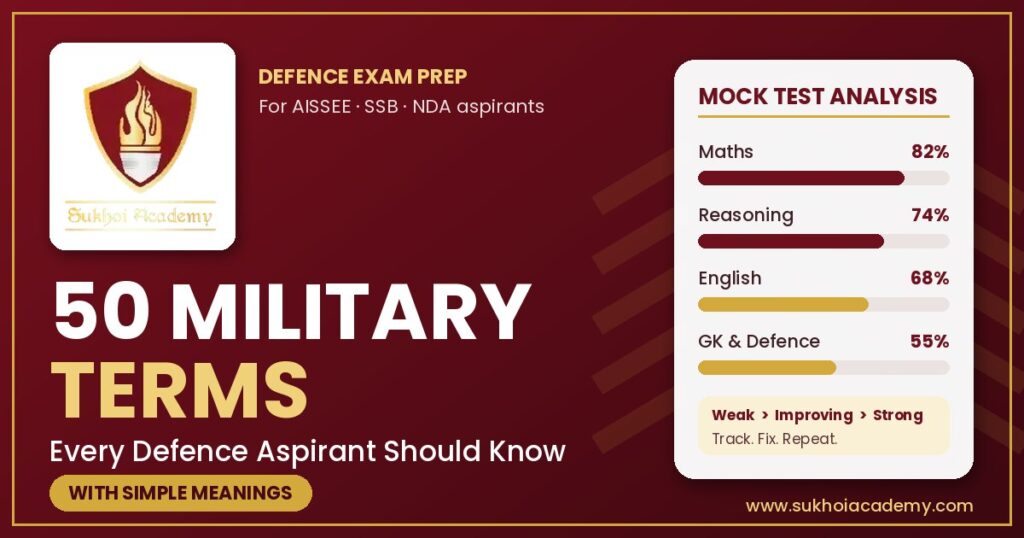
Next, make a small table after each test. Write the subject, the questions attempted, the questions correct and the accuracy. For example, a student attempts 40 maths questions and gets 30 right, so accuracy is 75%. Meanwhile, the same student attempts 20 general knowledge questions and gets 11 right, so accuracy is 55%. Clearly, general knowledge is the weak subject here.
Then set a target accuracy for each subject, such as 70%. Any subject below the target goes on your repair list.
Step 4: Improve Accuracy with an Error Notebook
Write each wrong question, the correct answer and the reason for the mistake. For military terms, add one flashcard per term. After that, revise the notebook after one day, three days and seven days. This spaced revision moves facts into long-term memory.
Step 5: Manage Time Section by Section
Start with your strongest section to build confidence. If a question stalls you, skip it and return later. Also, note which section drains your time. If you always rush the last section, move a few minutes from your strongest section to it in the next mock.
Step 6: Track Progress Every Week
Record three numbers after every mock: total score, accuracy and time left. Then compare them across the last three tests. A rising line means your plan works, while a flat line means you should change the method, not just study longer.
Step 7: Turn Weak Areas into Strengths with a 7-Day Repair Plan
Finally, pick one weak topic and follow this plan:
- Days 1–2: First, relearn the concept from your textbook or class notes.
- Days 3–4: Next, solve 20 fresh questions each day.
- Day 5: Then attempt a timed practice set.
- Retest day (Day 6): After that, retest every question you got wrong earlier.
- Day 7: Finally, take a short mock test and check the improvement.
Label each topic as weak, improving or strong. Once a topic stays strong for three tests, move to the next one. Over time, this routine converts weaknesses into scoring strengths.
What Are the Best Tips to Remember Military Terms for Defence Aspirants?
Try this simple 10-day plan. Learn five terms each day, quiz yourself the next morning and revise all 50 on day 11. In addition, these habits make the words stick:
- Group the terms by theme, as in this guide, instead of learning them alphabetically.
- Use each new word in a sentence about a real situation.
- Make flashcards with the term on one side and the meaning on the other.
- Read defence news for ten minutes a day and underline the terms you know.
- Teach five terms to a friend or sibling, because teaching is the best test.
Frequently Asked Questions
What are the basic military terms every beginner should know?
Start with armed forces, regiment, battalion, rank, recce, patrol and chain of command. These seven words appear most often in news and exam questions. After that, move on to the full list of 50 above.
What is the difference between a battalion and a regiment?
A battalion is a fighting unit of about 800 to 1,000 soldiers. A regiment in the Indian Army is a parent family of several battalions that share a name and traditions. Therefore, a regiment is about identity, while a battalion is about size and command.
How many military terms should I learn each day?
Five terms a day is a comfortable pace for school students, because it leaves time for revision and for mock tests. Older aspirants can double the pace if they revise twice.
Does mock test analysis really improve scores?
Yes, because analysis shows why you lost marks. A mock test without review only tells you the score, but with review, you learn which topics, mistakes and time habits to fix before the real exam.
How do I start AISSEE preparation as a parent?
First, read the syllabus and the exam pattern together with your child. Next, build a daily timetable and add one mock test every week. If you need expert guidance, the Sainik School admission process page explains the steps clearly.
Final Thoughts: Start with Five Terms Today
Learning military terms for defence aspirants will not decide your selection alone. However, it will make you more confident in classrooms, mock tests and interviews. So pick the first five terms today, quiz yourself tomorrow and keep a simple scorecard after every mock test.
Would you like trained mentors to guide the journey? Explore Sukhoi Academy’s Sainik School coaching programmes for structured classes, regular mock tests and personal feedback.