 MON - SAT 09: 00 AM - 06:00 PM (Sunday Closed)
Exam stress in children is common before the Sainik School entrance exam. Parents can reduce it in five ways. Spot early signs, keep routines calm, use mock tests for learning, protect sleep and praise effort instead of rank.
Your child may be preparing for the All India Sainik Schools Entrance Examination (AISSEE) or another military school test. Either way, the last few weeks can feel heavy. Children aged 10 to 15 are still learning how to handle pressure. That is why your support matters more than any extra study hour.
This guide shares eight simple ways to help. You can start with the first one today.
What Is Exam Stress in Children and Why Does It Rise Before Military School Exams?
Exam stress is the worry a child feels when a test seems bigger than their ability. A little stress is normal. It can even sharpen focus. Too much, however, hurts memory, sleep and confidence.
Military school tests add extra weight. The AISSEE is an offline, multiple-choice exam for Class 6 and Class 9 entry. Seats are limited, so children often hear, “This is your big chance.” Family hopes and classmate comparisons raise the pressure.
1. How Can You Spot the Early Signs of Exam Anxiety in Kids?
Children rarely say, “I feel stressed.” Instead, they show it through behaviour. Watch for these changes:
- Stomach aches or headaches before study time
- Trouble sleeping or frequent bad dreams
- Sudden anger, tears or long silences
- Avoiding books or making excuses
- Negative talk such as “I will fail anyway”
- Loss of appetite or constant snacking
One or two signs on a bad day are normal. However, signs that last two weeks or more need attention. Sit down, stay calm and listen first. Advice can wait.
2. Why Does a Calm Study Routine Reduce Exam Stress?
Routine is the quickest way to lower exam stress in children, because kids feel safer when the day has a clear shape. A simple study timetable for kids ends the daily arguments about when to study. Fix the study time, break time, play time and bedtime.
Keep each study block short. Forty minutes of focus followed by a ten-minute break works well for most children in this age group. Moreover, keep one evening a week free of books. Rest is part of preparation.
| Time | Activity | Why it helps |
| 4:00 PM | Snack and outdoor play | Resets the mind after school |
| 5:00 PM | Maths practice (40 min) | Hardest subject while energy is high |
| 5:50 PM | Reasoning or language (40 min) | Variety keeps attention fresh |
| 7:30 PM | Dinner and family time | Builds emotional safety |
| 8:30 PM | Light revision of the day’s mistakes | Strengthens memory |
| 9:30 PM | Lights out | Protects sleep |
3. How Can Mock Tests Build Confidence Instead of Fear?
An AISSEE mock test is a rehearsal. Unfortunately, many families treat it like a verdict. A low score then feels like failure, and anxiety grows.
Change the question at home. Instead of “What did you score?”, ask “What did we learn?” This one shift lowers fear quickly. Also, let your child take mock tests at the same time of day as the real exam. The exam hall will then feel familiar.
Good Sainik School coaching also includes regular tests with expert feedback. That takes the analysis load off parents.
A 5-Step Mock Test Analysis Plan
- Sort every wrong answer. Label it as a concept gap, a careless slip or a time problem.
- Rank subjects by accuracy. Maths usually carries the most marks, so check it first.
- Fix one weak topic per week. Practise 15 to 20 questions on it daily.
- Set time caps. Give each section a limit. Skip hard questions and return later.
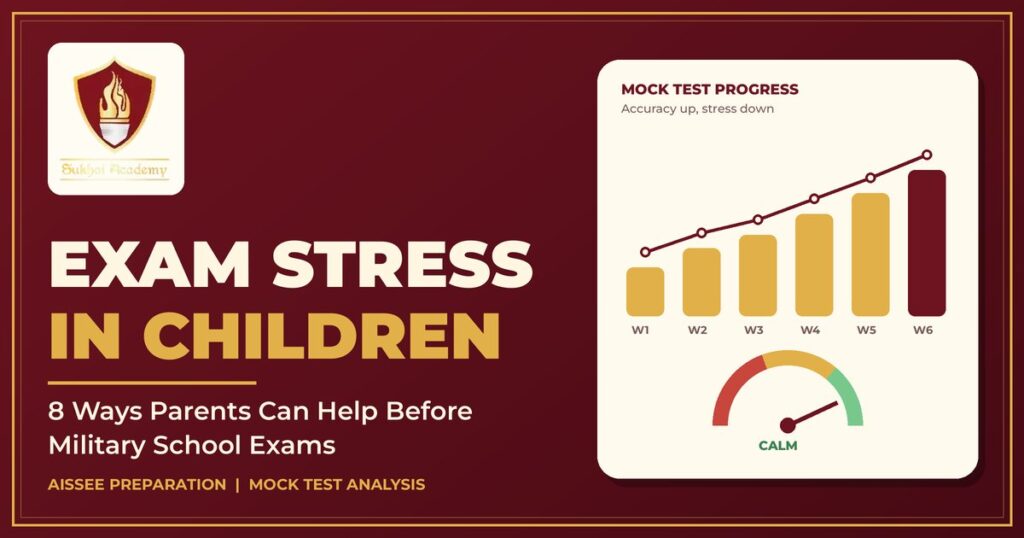
- Track progress weekly. Record the score and accuracy in a simple chart. Accuracy should rise before speed does.
The AISSEE has negative marking. Therefore, accuracy beats wild guessing. The table below shows how to turn each mistake type into a strength.
| Mistake type | What it looks like | How to fix it |
| Concept gap | Cannot start the question | Relearn the topic, then solve 15 questions |
| Careless slip | Knew it but marked wrong | Re-check units and option order |
| Time pressure | Many questions left blank | Use section timers and a skip rule |
4. Why Do Sleep, Food and Movement Matter So Much?
A tired body cannot learn well. Most children this age need between 8 and 11 hours of sleep. Our guide on diet and sleep for exam preparation explains how food and rest lift exam scores.
- Serve a protein-rich breakfast, such as eggs, paneer or dal chilla
- Keep water and fruit on the study table
- Switch off screens an hour before bed
- Add 30 to 60 minutes of outdoor play every day
Exercise also fits military school life, which values fitness and teamwork.
5. Should Parents Talk About Effort or Rank?
Words matter most when exam stress in children is high. Always choose effort. Children read our faces, and a frown at a low score speaks loudly. Say, “You stayed with that sum for 20 minutes,” rather than “You must top the list.”
Avoid comparing your child with cousins or classmates. Also avoid lines like “Your whole future depends on this.” Be honest instead. Seats are limited, but your child’s worth never depends on one result.
6. Which Calming Techniques Can Kids Learn Easily?
Kids need tools, not just advice. Teach these three simple methods:
- Box breathing: breathe in for 4, hold for 4, breathe out for 4, hold for 4. Repeat four times.
- 5-4-3-2-1 grounding: name 5 things you see, 4 you can touch, 3 you hear, 2 you smell and 1 you taste.
- Positive self-talk: replace “I can’t do this” with “I am still learning this.”
Practise together when your child is calm. Then the skill is ready when nerves appear.
7. How Do Small Goals Make AISSEE Preparation Easier?
A huge syllabus feels scary. Small goals feel doable. AISSEE preparation covers maths, language, reasoning and general knowledge, plus science and social science for Class 9. Split that list into weekly targets.
Put a wall chart where your child can see it. Write goals such as “finish fractions this week.” Tick each one when done. Every tick builds confidence. Spend ten minutes each Sunday reviewing progress together.
8. How Should Parents Prepare Children for Exam Day and Beyond?
Uncertainty feeds fear, so remove surprises. Check the exam centre route a day early. Pack the admit card, ID and pens as per the NTA instructions. Keep the night before light, with no new topics.
Many children also worry about leaving home for a hostel. Talk about it openly and early. Our guide on how to help a child adjust to boarding school gives parents a clear plan.
What Common Mistakes Should Parents Avoid During Exam Season?
Even loving parents add stress by accident. Check yourself against this list:
- Asking about marks every single day
- Adding extra tuition hours when the child is already tired
- Taking away play or sleep to “make up” for a bad test
- Sharing your own worry loudly in front of the child
- Comparing mock test ranks across children
Instead, ask one open question each evening, such as “What felt easy today?” Small, kind check-ins keep communication open without adding pressure.
When Should Parents Seek Extra Help?
Seek help if stress lasts several weeks or affects eating, sleep or daily life. Start with the school counsellor or a paediatrician. In India, you can also call the Tele-MANAS helpline at 14416. Asking for help is a sign of care, not weakness.
Frequently Asked Questions
How can I reduce exam stress in children before the Sainik School exam?
Keep routines steady and protect sleep. Add daily play, praise effort, and use mock tests as practice. Above all, stay calm yourself.
Is exam anxiety in kids normal?
Yes, mild worry is normal and even useful. It becomes a concern when it disturbs sleep, appetite or mood for weeks.
How many mock tests should my child take?
One full test a week suits most children in the early months. Two a week is fine in the final month. Reserve time to analyse each test, because that is where learning happens.
What should I say when my child scores low in a mock test?
Start with encouragement, such as “Thank you for trying.” Then review mistakes together. Pick one topic to improve this week.
Can coaching help with exam pressure?
It can. Structured classes, regular tests and expert feedback give children a clear path. Choose a programme with supportive teachers and small batches.
Final Thoughts: Your Calm Is Their Confidence
Exam stress in children fades when the home stays steady. Kids copy our mood, so calm parents help them feel safe enough to learn. Use these eight ways one at a time, and celebrate small wins along the way.