MON - SAT 09: 00 AM - 06:00 PM (Sunday Closed)
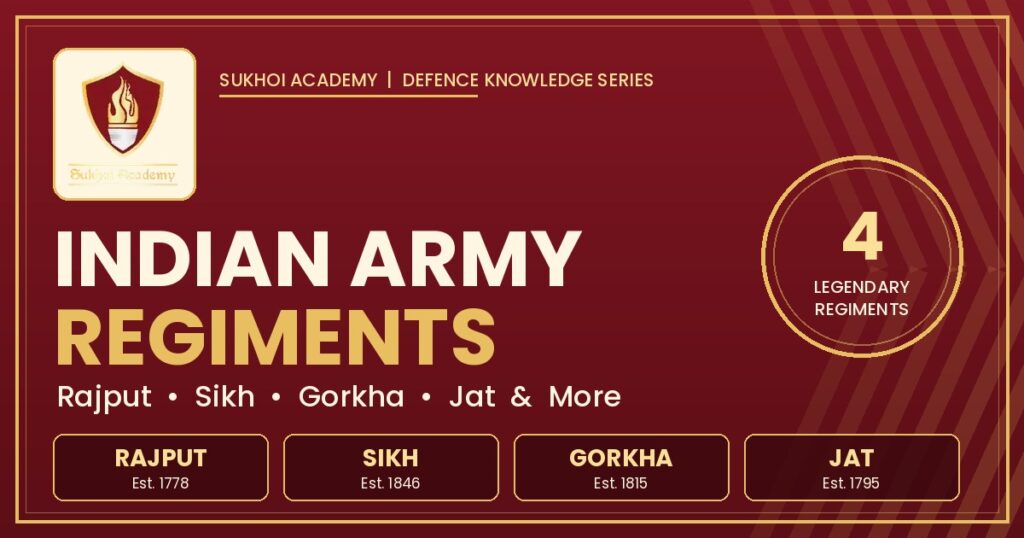
Indian Army regiments are historic fighting families, and each one has its own battle cry, flag and traditions. The best known include the Rajput, Sikh, Gorkha and Jat regiments. Each traces its roots to the 1700s or 1800s. Each has also earned gallantry awards in India’s major wars. This guide explains how they began, what makes them special and how a future officer can serve alongside them.
Students often ask the same questions. Which regiment is the oldest? Does a regiment depend on caste? Can an officer choose a regiment? So, below you will find clear answers. First, let us see how the regimental system works.
What Are Indian Army Regiments?
A regiment is the parent family of a group of battalions. A battalion has about 800 soldiers. Soldiers of one regiment share a flag, a battle cry and a regimental centre. As a result, they build deep pride and trust. People call this bond esprit de corps, and it keeps troops steady under fire.
The regimental system began under British rule. After 1947, India kept it because it works well. In fact, the infantry alone has over two dozen regiments, including seven Gorkha Rifles regiments.
Indian Army regiments also differ in how they recruit. Some draw soldiers from a single community. However, others mix several groups. Newer units take recruits from across the country. The table below explains the four common types.
| Type | What it means | Example |
| Single Class | Troops come from one class | Dogra Regiment |
| Fixed Class | Two or more groups, each sub-unit from one group | Rajputana Rifles |
| Mixed Fixed Class | Similar, but sub-units mix more than one group | Punjab Regiment |
| All India All Class | Troops from all over India, common in post-1947 units | Brigade of the Guards |
Rajput Regiment: One of the Oldest Infantry Units
The Rajput Regiment traces its lineage to 1778. That makes it one of the oldest infantry regiments in the Army. Its battle cry is “Bol Bajrang Bali Ki Jai”. Also, its regimental centre stands at Fatehgarh in Uttar Pradesh.
The regiment draws mainly Rajputs and men from nearby northern communities. Its battalions took part in the 1947–48 Jammu and Kashmir war. They have also served in later conflicts and counter-insurgency tasks.
However, do not confuse it with the Rajputana Rifles. That regiment dates to 1775 and uses the cry “Raja Ramachandra Ki Jai”. In 1948, Company Havildar Major Piru Singh of the Rajputana Rifles won the Param Vir Chakra, India’s highest gallantry award.
Sikh Regiment: Home of the Saragarhi Legend
The Sikh Regiment began on 1 August 1846. Its first units came from soldiers of the defeated Khalsa Army. Its battle cry is “Jo Bole So Nihal, Sat Sri Akaal”. Meanwhile, its regimental centre is at Ramgarh in Jharkhand.
Few Indian Army regiments have a story as famous as Saragarhi. On 12 September 1897, 21 Sikh soldiers held a small post on the North-West Frontier. They faced thousands of tribesmen. Havildar Ishar Singh led them, and all 21 fought to the end. Even now, their stand defines courage and duty in the Army.
Moreover, the Sikh Regiment holds 73 battle honours. It also counts two Param Vir Chakra winners: Lance Naik Karam Singh in 1948 and Subedar Joginder Singh in 1962. Also, the Army raised the Sikh Light Infantry in 1944.
Gorkha Rifles: The Khukri Warriors
The Gorkha Rifles are not one regiment. Instead, they form seven regiments with 39 battalions, as of 2020. These are 1, 3, 4, 5, 8, 9 and 11 Gorkha Rifles. Their battle cry is “Jai Ma Kali, Ayo Gorkhali”.
After 1947, India, Nepal and Britain signed the Tripartite Agreement. Six of the ten Gorkha regiments joined the Indian Army, and four went to the British Army. Later, India raised the 11 Gorkha Rifles for men of the 7th and 10th regiments who chose to stay.
The curved khukri is the symbol of Gorkha pride. Also, Field Marshal Sam Manekshaw served in the 8 Gorkha Rifles. Many credit him with a famous remark. A man who claims he never fears death, he said, is either lying or a Gorkha.
In addition, two Gorkha Rifles officers have won the Param Vir Chakra. Major Dhan Singh Thapa of 1/8 Gorkha Rifles earned it in 1962. Lieutenant Manoj Kumar Pandey of 1/11 Gorkha Rifles earned it posthumously at Kargil in 1999.
Jat Regiment: Strength, Speed and Sacrifice
The Jat Regiment traces its lineage to 1795. Its battle cry, “Jat Balwan, Jai Bhagwan”, means “Mighty Jat, victory to God”. The regiment has 22 regular battalions. Its regimental centre is at Bareilly.
The Jat Regiment mainly recruits Jats from Haryana, Rajasthan and western Uttar Pradesh. It also has a name for steady, determined fighting. For example, in September 1965, 3 JAT captured Dograi near Lahore.
Other Famous Indian Army Regiments You Should Know
Beyond these four, other Indian Army regiments have equally proud histories. The table below gives a quick comparison.
| Regiment | Lineage | Battle cry | Known for |
| Rajput | 1778 | Bol Bajrang Bali Ki Jai | Regimental centre at Fatehgarh |
| Sikh | 1846 | Jo Bole So Nihal, Sat Sri Akaal | Saragarhi; 73 battle honours |
| Gorkha Rifles | 1815 onwards | Jai Ma Kali, Ayo Gorkhali | Seven regiments, 39 battalions |
| Jat | 1795 | Jat Balwan, Jai Bhagwan | Capture of Dograi in 1965 |
| Dogra | 1877 | Jawala Mata Ki Jai | A single-class regiment |
| Garhwal Rifles | 1887 | Badri Vishal Lal Ki Jai | Two Victoria Cross winners |
| Kumaon | 1813 | Kalika Mata Ki Jai | Somnath Sharma and Shaitan Singh |
| Maratha Light Infantry | 1768 | Bola Shri Chhatrapati Shivaji Maharaj Ki Jai | Light infantry tradition |
| Mahar | 1815 | Bolo Hindustan Ki Jai | Machine-gun tradition |
| Madras | 1758 | Veera Madrassi, Adi Kollu, Adi Kollu | Oldest regiment in the Army |
Years show lineage as commonly cited. Many regiments trace their roots to earlier battalions.
The Kumaon Regiment’s Param Vir Chakra winners include Major Somnath Sharma and Major Shaitan Singh. Sharma won India’s first such award in 1947 at Badgam. Meanwhile, Shaitan Singh earned his at Rezang La in 1962.
Similarly, the Grenadiers count Abdul Hamid (1965), Hoshiar Singh (1971) and Yogendra Singh Yadav (1999) among their winners. The Garhwal Rifles also gave the Army two Victoria Cross heroes in World War I. They were Darwan Singh Negi and Gabar Singh Negi.
Can You Choose Your Regiment as an Officer?
Soldiers usually join a regiment based on region or class. However, officers follow a different path. They receive commissions through the National Defence Academy, the Combined Defence Services exam and other entries. Therefore, an army officer from any background can serve in any of the Indian Army regiments.
At the end of training, the Army allots regiments by merit, vacancies and preference. So, a higher rank in your batch gives you a wider choice. Rules can change, so always check the official Indian Army recruitment portal for updates.
How to Join the Indian Army as an Officer After Class 12?
The NDA exam is the main entry after Class 12. The Union Public Service Commission conducts it twice a year. First, you must clear the written test. Next, you must pass the SSB interview.
Good SSB interview preparation starts early. Our guide to the SSB interview process explains each stage in simple steps. In addition, it shows how to build confidence and clear thinking.
Strong NDA coaching builds your maths, English and general ability skills. Also, expert faculty at Sukhoi Academy guide you through every stage. Explore our NDA coaching programme to begin your journey.
For a full roadmap, read our post on how to get into NDA. However, younger students can start even earlier. Our Sainik School coaching prepares Class 6 and Class 9 candidates for a defence career.
Good defence exam coaching also builds discipline, reading habits and fitness. These qualities matter in every regiment. Above all, they help you stay calm in the SSB and in life.
Key Takeaways:
- Indian Army regiments are parent families of battalions, with a shared battle cry and centre.
- The Rajput, Sikh, Gorkha and Jat regiments trace their lineage to the 1700s and 1800s.
- Saragarhi, Rezang La and Kargil show the courage of Indian soldiers.
- Soldiers join by region or class, while officers get regiments by merit and vacancy.
- The NDA is the main route to become an officer after Class 12.
FAQs About Indian Army Regiments
How many Indian Army regiments are there?
The infantry alone has over two dozen regiments, including seven Gorkha Rifles regiments. Other arms, such as artillery, armoured corps and engineers, have their own units.
Which is the oldest regiment in the Indian Army?
Most sources cite the Madras Regiment, dating to 1758, as the oldest.
Is the Rajput Regiment the same as the Rajputana Rifles?
No. The Rajput Regiment dates to 1778 and the Rajputana Rifles to 1775. They have different battle cries and traditions.
Can I choose my regiment as an army officer?
The Army allots regiments to officers by merit, vacancies and preference. Caste or community does not decide the allotment.
What is the battle cry of the Sikh Regiment?
It is “Jo Bole So Nihal, Sat Sri Akaal”.
Final Thoughts on Indian Army Regiments
Indian Army regiments carry stories of courage that span more than two centuries. Whether it is Saragarhi, Rezang La or Kargil, these units shape the spirit of the Army. So, if you dream of leading such soldiers, start preparing today. Visit Sukhoi Academy or call +91-8792739294 to take the first step.