 MON - SAT 09: 00 AM - 06:00 PM (Sunday Closed)
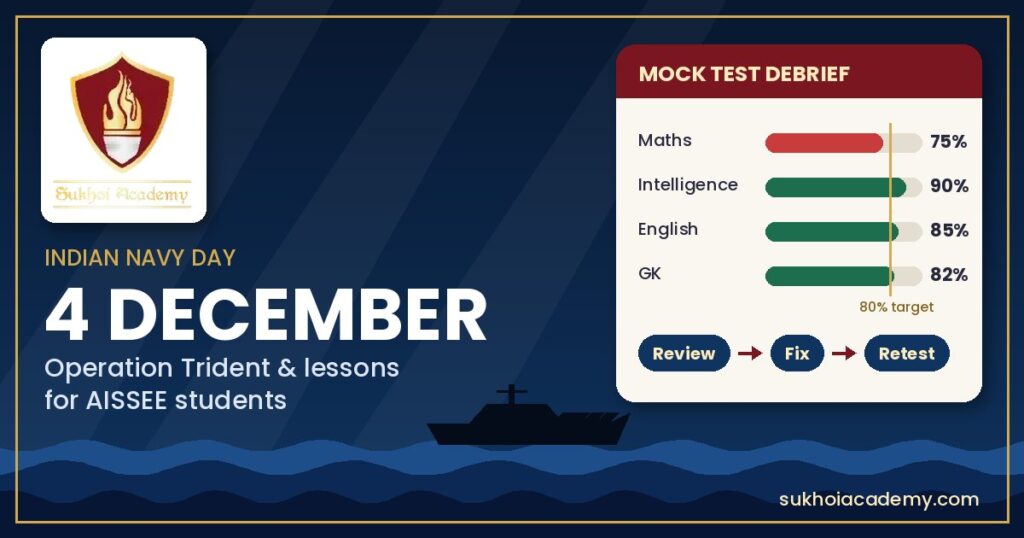
Indian Navy Day 4 December honours Operation Trident, the 1971 missile boat strike on Karachi harbour. In that night attack, the Indian Navy sank Pakistani vessels and set fuel tanks ablaze. India reported no losses. The story also holds useful lessons for AISSEE students, from careful planning to honest review after every mock test.
This year, 4 December falls on a Friday. The AISSEE 2027 exam is about eight weeks away. Therefore, it is a good moment to learn the history and then turn it into a study habit. This guide covers the facts, seven lessons and a simple debrief plan for your next mock paper.
What Is Indian Navy Day 4 December All About?
India observes Navy Day every year on 4 December. The day honours the Navy’s role in the 1971 war with Pakistan. It also remembers the sailors who gave their lives. The date marks Operation Trident, which took place on the night of 4 to 5 December 1971.
The background is important. On 3 December 1971, Pakistan bombed nine Indian airfields. The Navy answered the very next night with a bold strike on Karachi.
What Happened During Operation Trident?
Three missile boats led the strike: INS Nipat, INS Nirghat and INS Veer. Each boat carried four Styx missiles. Two ships, INS Kiltan and INS Katchall, sailed with them. The tanker INS Poshak supported the group. Cdr Babru Bhan Yadav, who commanded the 25th Missile Boat Squadron, led the task force.
The group approached Karachi from the south, outside the range of Pakistani air surveillance. Then it struck at night. It was the first use of anti-ship missiles in combat in the region.
Operation Trident at a glance:
| Fact | Detail |
| Date | Night of 4 to 5 December 1971 |
| Place | Arabian Sea, off Karachi harbour |
| Indian strike group | INS Nipat, INS Nirghat and INS Veer, with INS Kiltan, INS Katchall and tanker INS Poshak |
| Pakistani vessels sunk | PNS Khaibar, PNS Muhafiz and MV Venus Challenger |
| Also hit | PNS Shah Jahan was badly damaged. The Kemari oil storage tanks burned. |
| Indian losses | None reported |
| Follow-up | Operation Python, 8 December 1971 |
| Leader honoured | Cdr Babru Bhan Yadav, Maha Vir Chakra |
Why Do We Still Remember Operation Trident?
Many accounts rank Trident among the most successful naval operations since World War II. A small group of fast boats achieved a large result without a single Indian casualty. The strike also shifted the momentum of the war in India’s favour. Operation Python followed on 8 December and added to the damage at Karachi. That is why Indian Navy Day 4 December remains a proud date on the national calendar.
What Can AISSEE Students Learn from Navy Day?
Good Sainik School coaching teaches more than Maths and general knowledge. It also builds the habits of a future officer. Operation Trident, the heart of Indian Navy Day 4 December, shows those habits in action. Here are seven lessons that students and parents can use right away.
Lesson 1: Plan Before You Act
Trident worked because planners thought through every detail in advance. Students can copy this approach. Write a weekly timetable, and give each subject a clear slot.
Lesson 2: Play to Your Strengths
Missile boats were small, fast and hard to detect. Planners used that edge fully. In the same way, notice your strong subjects and protect those marks. Then give weak subjects extra time.
Lesson 3: Work as a Team
Boats, ships and a tanker each had a job. No single vessel won the night. Likewise, parents, teachers and students should follow one shared preparation plan.
Lesson 4: Rehearse Until It Feels Routine
Naval crews rely on drills so that actions become second nature. AISSEE preparation works the same way. Daily practice makes exam day feel familiar instead of frightening.
Lesson 5: Stay Calm Under Pressure
Night operations demand a steady mind. During the exam, take a deep breath and read each question twice. If a question looks hard, mark it and move on.
Lesson 6: Review Every Mission
Armed forces hold a debrief after every operation. A mock test deserves the same treatment. The next section shows exactly how to do it.
Lesson 7: Honour Those Who Serve
Navy Day reminds us of the sailors who gave their lives. Respect and gratitude shape character. In defence selection, character counts as much as marks.
How Do You Debrief an AISSEE Mock Test Like the Navy?
A mock test helps only when you study the result. Use this seven-step debrief after every paper. It works for both Class 6 and Class 9. For a deeper walkthrough, read our guide to AISSEE mock test analysis.
- Record the scorecard. Note marks, attempts and correct answers for each section. Also note the minutes left at the end.
- Find the weak subject. Divide correct answers by attempts to get accuracy for each section. As a simple rule, treat accuracy below 80 per cent as weak. Maths carries about half the marks in both papers, so repair it first.
- Sort every mistake by cause. Label each wrong answer as a concept gap, calculation slip, time pressure or misread question. Each type needs a different fix.
- Improve accuracy. Write each error in a notebook with the correct method. Review that notebook twice a week. Slow down on questions you often misread.
- Manage your time. Both papers allow about 1.2 minutes per question. If a question takes more than two minutes, skip it and return later. Practise this skip-and-return habit in every mock.
- Track progress weekly. Keep a simple log of score, accuracy, time left and top mistake type. A rising line shows the plan works. A flat line means the plan needs a change.
- Turn weakness into strength. Pick one weak topic each week. Relearn it, practise fresh questions and retest it in a timed set. Move on only when it stays strong for three tests.
A Quick Example of the Debrief in Action
Imagine a Class 6 student who attempts 40 Maths questions and gets 30 right. Accuracy is 75 per cent, which is below the 80 per cent target. Most errors are calculation slips in fractions. So the student practises ten fraction sums daily for a week. If accuracy reaches 85 per cent in the retest, fractions move to the strong list.
Sample 7-day repair plan for one weak topic
| Day | What to do? |
| Days 1 and 2 | Relearn the concept from class notes or the textbook |
| Days 3 and 4 | Solve 20 fresh questions each day |
| Day 5 | Take a timed 15-minute sectional set |
| Day 6 | Revise the error notebook entries for this topic |
| Day 7 | Retest and update the progress log |
How Does Indian Navy Day 4 December Fit Into Your AISSEE 2027 Preparation?
The AISSEE 2027 exam is scheduled for 31 January 2027. Applications were due by 2 December 2026, so check the official NTA bulletin for any late window. Our guide to the Sainik School admission form 2027 lists the dates and steps.
With about eight weeks left after Navy Day, plan one full-length AISSEE mock test each week. Then spend an hour on the debrief. This habit builds accuracy and speed far better than extra hours of unreviewed practice.
Facts from Indian Navy Day 4 December are also good general knowledge. Keep a short notebook for defence news. Whether you choose self-study or defence exam coaching, the debrief habit matters most.
Dreaming of a Navy career? Many Sainik School students aim for the NDA after Class 12, and the Navy wing needs Physics and Maths. You may also enjoy our Air Force Day lessons for students.
Frequently Asked Questions About Indian Navy Day
Why is Navy Day celebrated on 4 December?
Navy Day marks Operation Trident, the Indian Navy’s missile boat attack on Karachi harbour on the night of 4 to 5 December 1971. The day also honours sailors who died in the 1971 war.
What was Operation Trident?
Operation Trident was a night strike by Indian missile boats on Karachi during the 1971 war. It sank three vessels, damaged another and set the Kemari oil storage tanks on fire. India reported no losses.
Which ships took part in Operation Trident?
The missile boats INS Nipat, INS Nirghat and INS Veer carried out the strike. INS Kiltan, INS Katchall and the tanker INS Poshak supported them.
Is Navy Day useful for the AISSEE general knowledge section?
Yes. Defence history and national events are good general knowledge for young aspirants. Knowing Navy Day facts also helps in later interviews, though students should always follow the latest AISSEE syllabus.
How often should a student take an AISSEE mock test?
Most students do well with one full-length mock test every week, followed by a careful debrief. Shorter sectional tests can fill the days in between.
Final Thoughts: Turn Navy Day Into a Study Day
Operation Trident was won by planning, teamwork and calm under pressure. Your AISSEE journey rewards the same qualities. Use Indian Navy Day 4 December to share one fact with your child today. Then schedule this week’s mock test and the debrief that follows. To explore structured preparation, visit Sukhoi Academy.